
Feature
November 10, 2026
COLD WAR FILES
By
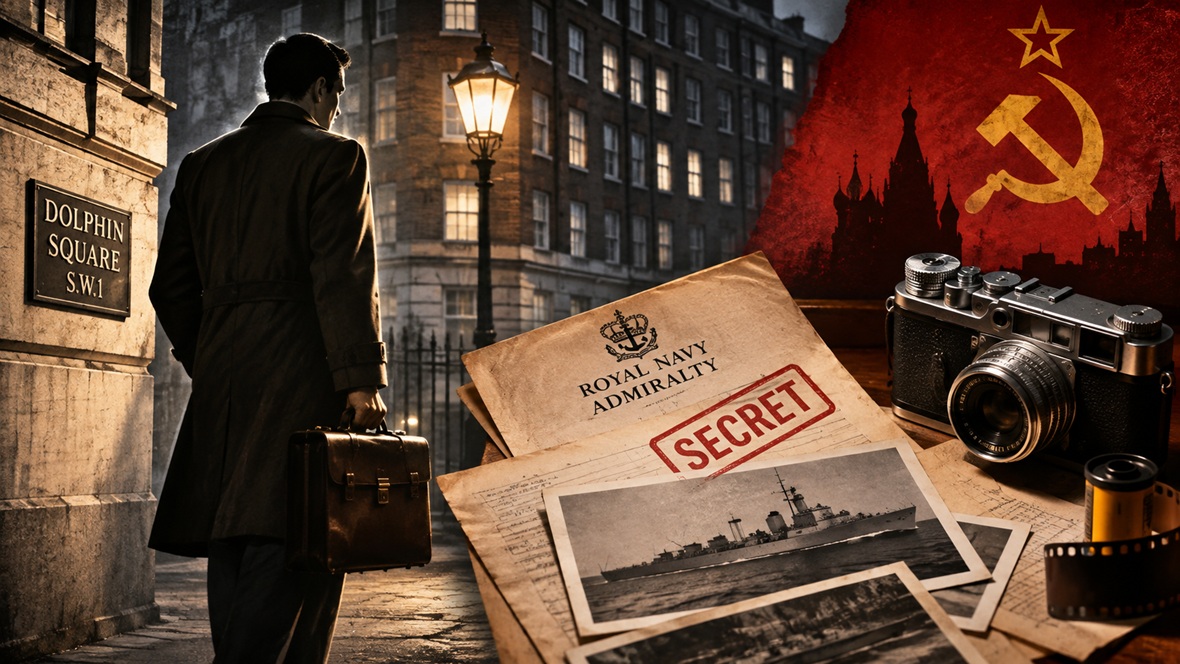
The Clerk of Dolphin Square
John Vassall was a junior Admiralty clerk on about £700 a year. For seven years he carried Royal Navy secrets home in his briefcase, photographed them on his dining table, and passed them to the KGB. His exposure in 1962 sent two reporters to prison, ended a minister’s career, and left British security officials asking a question they never fully answered.
On the evening of 12 September 1962, John Vassall left the Admiralty on Whitehall at the end of an ordinary working day. He was thirty-seven, a clerical officer in Military Branch II, a section that handled fleet operations and naval planning papers. Detectives from Special Branch stopped him in the street. Within hours they were inside his flat at Dolphin Square, the large riverside block in Pimlico favoured by MPs, officers and civil servants. In a hidden compartment in a piece of furniture they found cameras and rolls of exposed film. Some of the frames showed Admiralty documents marked secret.
Vassall did not fight. By most accounts he was frightened and talkative, and he gave a long confession at New Scotland Yard that night. Six weeks later he stood in the dock at the Old Bailey, pleaded guilty, and received eighteen years.
That might have been the end of a tidy espionage prosecution. It became something much larger. Over the following seven months the Vassall case produced a ministerial resignation, a judicial tribunal, the jailing of two Fleet Street journalists, and a bitter feud between Harold Macmillan’s government and the national press. When the Profumo affair broke in 1963, newspapers that had been humiliated over Vassall had no intention of giving ministers the benefit of the doubt.
The case also left a residue of doubt inside British counterintelligence. The material Vassall admitted taking did not account for everything the Admiralty believed had leaked. Some officers concluded there was a second, more senior source who was never found.
The Vicar’s Son
William John Christopher Vassall was born on 20 September 1924 in Ely, Cambridgeshire. His father was a Church of England clergyman, and the family had good connections and little money. His mother later converted to Roman Catholicism, and Vassall followed her into the Church in 1953. He was known all his life as John.
He left school without a university place and went into clerical work. During the Second World War he served in the Royal Air Force as a photographer, a skill that would matter later. In 1946 he took a job as a clerk at the Admiralty, the lowest rung of a department that ran the Royal Navy and guarded a great deal of its secret technical work.
Colleagues described him as fussy, mannered and keen to be liked by people of higher rank. Supervisors in later years called him plodding. Nobody thought of him as dangerous. That reputation was one of his most useful assets once he started spying.
Vassall was gay at a time when sex between men was a criminal offence in England and Wales, and would remain so until 1967. In the Civil Service of the early 1950s, after Guy Burgess and Donald Maclean fled to Moscow in 1951, homosexuality was treated as a security risk in its own right. The logic was simple. A man with a secret that could cost him his job and his liberty could be blackmailed. The policy that flowed from that logic made the blackmail more effective, because it raised the price of exposure.
Moscow, 1954
In 1954 Vassall was posted to the British Embassy in Moscow as clerk to the Naval Attaché. Moscow was a hardship post. Food and fuel were short, travel was restricted, and contact with ordinary Russians was watched by the Second Chief Directorate of the newly formed KGB, the arm responsible for counterintelligence and for working against foreign diplomats.
The embassy employed locally engaged staff to handle the practical business of living in the Soviet capital: interpreters, drivers, fixers who could find theatre tickets and get a car repaired. One of them was a Pole named Sigmund Mikhailski. He worked in the embassy’s administrative section and moved easily among the junior British staff. He was also working for Soviet intelligence.
Mikhailski cultivated Vassall over several months. He took him around the museums and restaurants of Moscow and introduced him to a circle of Russian men. According to the declassified material later compiled on the case, in October 1954 the two men dined at the Aurora Restaurant. A few days later Vassall was invited to a party in a private room above a restaurant. He was given a great deal to drink. At some point he was photographed in sexual situations with several men.
Vassall’s own account, given in his confession and repeated in his 1975 memoir, was that he had been drugged. The historian Alex Grant, who examined the case files for his 2023 book Sex, Spies and Scandal, goes further and argues that what happened in that room was a sexual assault, staged by the KGB and photographed so it could be used against him. The trial judge and the newspapers of 1962 described it as a seduction. The difference matters. It makes Vassall the victim of a planned operation rather than a willing participant in his own compromise.
The KGB did not need Vassall to believe in communism. It needed him to believe that refusal would destroy him.
Some weeks later Vassall was summoned to a meeting with men who identified themselves as officials. They showed him the photographs. They told him that homosexual acts were a crime in the Soviet Union and that he could be prosecuted. Then they offered him a way out. He could work for them.
Here the record shows the KGB’s method clearly. The officers did not ask for naval secrets at once. They asked for information about the embassy: who worked there, what they did, who among the staff might be engaged in intelligence work. Vassall agreed. Each small betrayal made the next one easier to demand, and it gave his handlers material that could be used against him if he ever thought of confessing to his own side.
Vassall had a clear choice at that moment. He could have walked into the ambassador’s office and reported the approach. The embassy security officer would have sent him home, and his career would probably have ended. He would not have gone to prison. He chose to keep quiet. Later, Rebecca West, who covered the case and wrote a short book on it in 1963, argued that he may have gone to Moscow already willing to sell information. Sir William Hayter, the ambassador at the time, dismissed that idea. The evidence does not settle it either way.
An Agent in Whitehall
Vassall returned to London in July 1956. A Soviet asset in a Moscow embassy has a limited shelf life. An asset inside the Admiralty in London, with a security clearance and a reason to handle classified papers every day, was worth far more. The KGB arranged for contact to continue, and Vassall resumed work in Whitehall.
He went first to the Naval Intelligence Division. In 1957 he moved into the private office of Thomas Galbraith, the Civil Lord of the Admiralty, a junior ministerial post. He worked there until 1959, handling the minister’s papers and correspondence. Then he was promoted and moved to Military Branch II, where the documents crossing his desk included material on naval tactics, fleet dispositions, and equipment such as radar, torpedoes and anti-submarine systems. Some of it came from NATO.
His method was low-tech and steady. He took documents home in his briefcase, photographed them in his flat, and returned them the next morning. MI5 later established that he did this on a regular basis, sometimes almost daily. The Admiralty had no system for checking what left the building at night in a clerk’s bag. Nobody searched briefcases, and nobody logged who had drawn which file.
His handlers in London met him at pre-arranged sites around the city and its suburbs. Vassall later told interrogators that the KGB made heavy use of the Underground to move to and from meetings, which made surveillance harder. In Christopher Andrew’s authorised history of MI5, Vassall’s principal London controller is identified as Nikolai Rodin, a senior KGB officer who operated under the name Korovin.
The money changed his life. Vassall’s Admiralty salary was roughly £700 a year. He rented a flat in Hood House at Dolphin Square, an address well beyond the reach of most clerical officers. He wore Savile Row suits, bought antiques, and took holidays abroad, including trips to Capri and the Mediterranean. Colleagues noticed. Some assumed he had family money. Nobody in authority asked him to explain the gap between his income and his spending.
Nobody in authority asked a £700-a-year clerk how he paid for Dolphin Square.
For a counterintelligence officer, this is the most uncomfortable part of the file. The tell was visible for years. In 1961 the Admiralty was already reeling from the Portland spy ring, in which Harry Houghton and Ethel Gee had passed secrets from the Underwater Detection Establishment at Portland to Konon Molody, the KGB illegal known as Gordon Lonsdale. Houghton had also lived far beyond his means. The lesson was available, and it was not applied to a clerk in Whitehall.
The Defectors
Vassall was caught because people on the other side talked. In December 1961 Anatoliy Golitsyn, a KGB major serving in Helsinki, defected to the CIA. Golitsyn brought a large volume of leads, some precise and many vague, and he spent years afterwards feeding mole hunts in Washington and London. Among his leads was information pointing to a Soviet source in the British Admiralty.
In June 1962 a second KGB officer, Yuri Nosenko, made contact with the CIA in Geneva. Nosenko served in the Second Chief Directorate, the very department that targeted foreign diplomats in Moscow. His information about a British naval clerk compromised in Moscow was more specific. MI5 and the Admiralty had been aware of a problem since at least April 1962, according to the later tribunal report. With Nosenko’s details, the list of possible candidates narrowed to Vassall.
MI5 put him under observation. Officers looked at his finances, his flat and his routine. The investigation moved quickly once the identification was made, and he was arrested in September. The MI5 officer Charles Elwell, who later handled much of the interrogation and debriefing, built a working relationship with Vassall that produced a large amount of detail about Soviet tradecraft and about other people Vassall had known. According to Alex Grant, that information damaged several careers.
Nosenko’s role later became a source of argument. Elements of the CIA, led by counterintelligence chief James Angleton and influenced by Golitsyn, came to believe Nosenko was a false defector sent to mislead the West. If that were true, giving up Vassall could have been a deliberate sacrifice: hand over a minor agent to protect a more valuable one. The theory has never been proved, and Nosenko was eventually accepted as genuine by the CIA after years of hostile detention. The suspicion attached to the Vassall case anyway.
Guilty as Charged
Vassall’s confession was detailed and quick. He described the Moscow compromise, the meetings, the cameras and the routine. He was charged under the Official Secrets Act. On 22 October 1962, at the Old Bailey, he pleaded guilty and was sentenced by the Lord Chief Justice, Lord Parker, to eighteen years’ imprisonment. The date fell in the middle of the Cuban Missile Crisis, which gives some sense of the atmosphere in which the sentence landed.
Eighteen years was heavy for a clerk, though lighter than the forty-two years George Blake had received the year before. In passing sentence, the court treated the Moscow episode as a weakness Vassall had chosen to indulge. The idea that he had been drugged and abused was not part of the public story.
The Galbraith Letters
The trial was short because Vassall pleaded guilty. That left the newspapers with a story and very little official detail. They filled the gap themselves.
Reporters went looking for people who had known Vassall at school, in the RAF and at the Admiralty. Papers ran stories about his clothes, his manners and his social life. One reporter claimed colleagues had called him Auntie. Another wrote that he bought women’s clothing in a West End store. The coverage was openly contemptuous of his sexuality, and it carried a political charge. If a man like this had been allowed near secrets for seven years, who had protected him?
The obvious target was Thomas Galbraith, the former Civil Lord, by then Under-Secretary of State for Scotland. Police had found letters from Galbraith among Vassall’s papers. Rumours spread that the two men had been close friends, that Vassall had stayed at Galbraith’s home in Scotland, and that they had planned to meet in Italy.
The government decided to publish the letters in a White Paper to prove they were harmless. The tactic backfired. The letters were dull and routine, covering office matters and the minister’s arrangements, with a friendly tone. Their very ordinariness was read by some as a cover. Galbraith resigned in early November 1962, a few weeks after the trial. He had done nothing wrong, and the resignation looked like an admission of something.
An initial inquiry by three senior civil servants cleared him. The Labour opposition and much of the press did not accept the result. Macmillan then appointed a full tribunal of inquiry under Lord Radcliffe, with Mr Justice Barry and Milner Holland QC, and gave it powers to compel evidence.
Radcliffe and the Silent Journalists
The Radcliffe Tribunal sat through the winter of 1962 and 1963. It examined the security arrangements at the Admiralty and the Moscow embassy, and it examined the press. Journalists were called and asked to substantiate their stories and identify their sources.
Some of the evidence was grimly comic. One reporter described interviewing Vassall’s former teachers and classmates, who remembered him as strange. Another explained that his assignment had been to establish whether Vassall moved in homosexual circles. Many of the most damaging claims turned out to rest on gossip, guesswork, or nothing at all.
Two reporters refused to name their sources. Brendan Mulholland of the Daily Mail and Reginald Foster, a veteran crime reporter freelancing for the Daily Sketch, stood on the principle that a journalist does not give up a confidential informant. The tribunal referred them to the High Court for contempt. Mulholland was sentenced to six months and Foster to three. Foster, then fifty-eight, was released after sixty-one days. Fleet Street called them the Silent Journalists.
The tribunal reported on 25 April 1963. Its report ran to roughly 50,000 words. It found no improper relationship between Galbraith and Vassall and described the allegations against him as unfounded. It cleared Lord Carrington, the First Lord of the Admiralty, and the service chiefs, finding that they had first been warned in April 1962. It found that nobody at the Admiralty was to blame for failing to identify Vassall as a risk, while accepting that the vetting process after his return from Moscow had been weak and that at least one official had made errors of judgment.
Critics called it a whitewash. Galbraith, cleared, later returned to junior office. The two journalists had served their sentences for refusing to support stories the tribunal had largely found to be untrue. The press drew its own conclusion: the government had used a judicial inquiry to punish reporters. That anger was still fresh a few weeks later, when the War Secretary, John Profumo, was found to have lied to the Commons about his relationship with Christine Keeler, who had also been involved with Yevgeny Ivanov, a Soviet naval attaché. Newspapers that had been burned on Vassall went after Profumo with no restraint at all.
The Second Man
Inside the Admiralty and MI5, the scandal was less important than one technical problem. When damage assessors compared what Vassall admitted taking with what they believed the Soviets knew, the numbers did not match. Some of the compromised material had never passed through his hands.
There are several possible explanations. Vassall may have forgotten or minimised parts of what he took. The Portland ring and other sources may account for some of the gap. The KGB may also have had another agent in the naval establishment, someone more senior, whose existence Vassall’s arrest was meant to hide. That last theory fitted neatly with the Golitsyn view of Nosenko as a plant, and it fed the long, corrosive mole hunts of the 1960s and 1970s on both sides of the Atlantic.
No second Admiralty spy from that period was ever publicly identified. The question remains open in the literature, and the released files do not close it.
John Phillips
Vassall served ten years. He was by all accounts a model prisoner, and he was released on parole in 1972. In 1975 he published Vassall: The Autobiography of a Spy, which presented him as a victim of blackmail and of the society that made blackmail possible. He showed little interest in politics. He told people he had never wanted to go back to Moscow.
He changed his name to John Phillips and took a quiet clerical job, working for a time in an archive, where colleagues knew nothing of his past. He lived in London, attended Mass, and avoided publicity. He died in London on 18 November 1996, aged seventy-two.
In 2017 and the years that followed, the National Archives released Cabinet Office files on the Radcliffe Tribunal, including evidence about his time in Moscow and correspondence about defector information. Those files and Alex Grant’s research have pushed the story away from the 1962 version of a weak, vain clerk who betrayed his country for money and pleasure. The newer account is of a man assaulted in a trap, coerced, and then paid well enough that he stopped resisting. Both versions contain truth. He was a victim in October 1954. He was a paid agent for the next eight years.
What the Case Teaches
The Vassall file is still taught for good reason. Its lessons are specific and testable.
Local staff in hostile capitals are an access route. Mikhailski had daily contact with junior embassy personnel and the freedom to arrange their social lives. After the case, the Foreign Office reduced its reliance on Soviet bloc nationals in sensitive posts. Any service operating in a hostile country should assume that every locally engaged employee reports to the host service, whatever their individual loyalties.
Compromise usually starts small. The KGB’s first request was for gossip about embassy staff. That is still the standard pattern in documented recruitment cases. A security briefing that teaches staff to report the first awkward approach, and promises proportionate treatment if they do, removes the blackmailer’s main weapon. Vassall stayed silent because he believed reporting would cost him everything. A policy that would have sent him home with a reprimand might have stopped the operation in 1954.
Debrief people returning from hostile postings. Vassall came home from two years in Moscow and went straight to the Naval Intelligence Division. The Radcliffe report singled out the weakness of his vetting after that return. A structured interview, a review of his contacts in Moscow, and a check of his finances six months later would have been cheap.
Measure lifestyle against income. A clerk earning £700 paying Dolphin Square rent, buying tailored suits and travelling abroad was a signal. Houghton at Portland showed the same pattern. Aldrich Ames at the CIA, three decades later, paid cash for a $540,000 house on a salary of under $70,000. The check is simple arithmetic, and services keep failing to do it.
Control what leaves the building. Vassall removed documents for years without being challenged. Spot checks of bags at exits and logs of who draws which files would have made his routine far riskier.
Treat defector leads with care in both directions. Golitsyn and Nosenko together found Vassall. The argument about their reliability then consumed years of counterintelligence effort and damaged innocent officers. A lead that produces an arrest still needs to be tested on its own merits.
The last lesson is the hardest. The policy that excluded gay men from sensitive work was meant to close a vulnerability. In practice it made the vulnerability worse, because it handed the KGB its blackmail material. Britain lifted its ban on gay people holding the highest security clearances in 1991. GCHQ’s director apologised in 2016 for the way the agency had treated gay staff. Security services now treat honesty about personal life as the protection, because a secret that carries no penalty cannot be used for blackmail.
Timeline
1924
Born 20 September in Ely, Cambridgeshire
1946
Joins the Admiralty as a clerk
1954
Posted to Moscow as clerk to the Naval Attaché; compromised in October
July 1956
Returns to London; joins Naval Intelligence Division
1957–1959
Works in the private office of Civil Lord Thomas Galbraith
1959
Promoted; moves to Military Branch II
Dec 1961
Anatoliy Golitsyn defects to the CIA in Helsinki
June 1962
Yuri Nosenko contacts the CIA in Geneva
12 Sept 1962
Arrested; confesses at New Scotland Yard
22 Oct 1962
Pleads guilty at the Old Bailey; sentenced to 18 years
Nov 1962
Galbraith resigns as Under-Secretary of State for Scotland
Early 1963
Mulholland and Foster jailed for contempt
25 Apr 1963
Radcliffe Tribunal reports; clears Galbraith and Carrington
1972
Released on parole
1975
Publishes his autobiography
18 Nov 1996
Dies in London, aged 72
Sources and Further Reading
Andrew, Christopher. The Defence of the Realm: The Authorized History of MI5. Allen Lane, 2009.
Grant, Alex. Sex, Spies and Scandal: The John Vassall Affair. Biteback Publishing, 2023.
Vassall, John. Vassall: The Autobiography of a Spy. Sidgwick & Jackson, 1975.
West, Rebecca. The Vassall Affair. Sunday Telegraph, 1963.
Report of the Tribunal Appointed to Inquire into the Vassall Case and Related Matters (Cmnd. 2009). HMSO, April 1963.
The National Archives, Kew. CAB 301/265–267, Radcliffe Tribunal papers, opened 2017.
Barnes, Trevor. Dead Doubles: The Extraordinary Worldwide Hunt for One of the Cold War’s Most Notorious Spy Rings. Weidenfeld & Nicolson, 2020.
Leitch, David. “Obituary: John Vassall.” The Independent, 9 December 1996.
FOLLLOW THE LEAD
Onr discovery leads to another.

Cryptograms: What They Are and How to Solve Them
Dead Drops: How They Really Work
The NSA’s Biggest Shake-Up in a Decade