
Feature
November 8, 2026
The FBI Tunnel Under the Soviet Embassy
What We Know About Operation Monopoly
By ISDb Editor
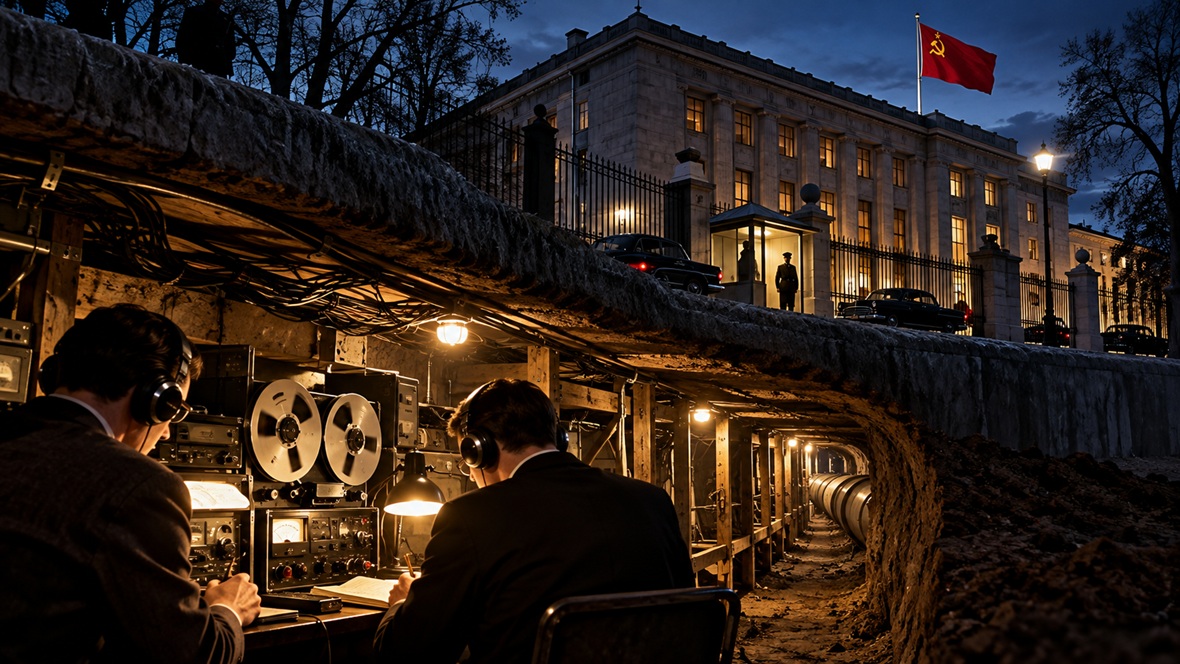
A research brief on the Cold War eavesdropping tunnel beneath Mount Alto, Washington, D.C.
For more than ten years, the FBI and the National Security Agency ran a tunnel under the Soviet Union’s new embassy complex on Wisconsin Avenue in northwest Washington. The project cost several hundred million dollars. It may never have produced a single useful piece of intelligence. And the Soviets knew about it for roughly twelve years before the American public did, because an FBI counterintelligence agent named Robert Hanssen sold them the secret.
The government has never officially confirmed the tunnel. Most of what is known comes from a March 2001 New York Times report, follow-up stories in the Washington Post and Newsweek, David Wise’s 2002 book Spy, and the FBI affidavit filed against Hanssen. Those sources disagree on several points, and this brief flags where they do.
Why the FBI wanted a way in
In 1969 the Soviet Union signed an 85-year lease on the site of the former Mount Alto Veterans Hospital, above Georgetown in what is now Glover Park. A 1972 agreement tied the project to a new American embassy in Moscow: both countries would build at the same time, and neither could move in until the other was ready. Construction on Mount Alto began in 1977.
U.S. intelligence agencies hated the site. Mount Alto sits about 350 feet above sea level, one of the highest points in the District, with a clear line of sight to the White House, the Capitol, the State Department and the Pentagon. Microwave telephone traffic between those buildings could be intercepted from the roof. Former FBI agent Dick Alu later told Wise that the State Department never consulted the FBI or NSA before offering the land. The CIA, NSA and FBI each wrote studies opposing it, according to Ronald Kessler’s 1987 reporting for The Washingtonian.
The FBI’s answer was to get underneath the building while it was still a construction site. The program was code-named Monopoly.
How the operation worked
Accounts of the construction vary, but the outline is consistent:
• Cover. FBI agents took jobs with key contractors the Soviets hired, and the Bureau recruited some genuine construction workers to plant bugs in the structure. The GSA official responsible for the property was asked to cut down three perimeter trees and disguise the stumps so the FBI had a clear view of the site.
• Observation. A house across the street watched the site around the clock. Neighbors told Washingtonian in 2023 that 2619 Wisconsin Avenue served as an FBI observation post from roughly 1990 to 2013, with agents working eight-hour shifts and cameras on tripods behind tinted skylights.
• The dig. Soil from the tunnel was reportedly carried out at night and added to the existing dirt piles from the embassy excavation. The embassy’s own architect, John Carl Warnecke, said in 2001 that he had no idea it existed and could not see how anyone hid the spoil.
• Equipment. As each section was finished, the NSA installed collection gear. Newsweek reported that it included laser systems meant to read vibrations from the keystrokes of Soviet cipher machines. Others in the tunnel were meant to tap telephone cables inside the complex.
• Partners. Newsweek also reported that Britain’s MI5 assisted the FBI and NSA.
Working conditions were bad. Newsweek’s sources described methane pockets that ignited more than once, a constant risk of flooding, and crews under such sustained stress from living undercover that some received psychological counseling. The tunnel leaked water throughout its life.
The engineers also had a basic targeting problem. They had the building plans but not the floor-by-floor use of each room. One FBI participant told Wise the fear was surfacing under a copy room or a storage closet when what they wanted was a break room where people talked, or the secure room where diplomats assumed nobody could hear them.
What the Soviets did to stop it
Moscow assumed the Americans would try something. Warnecke described Soviet crews taking apart and inspecting every window frame before installation, X-raying structural steel the night before it went up, and specifying solid marble facing instead of thin marble panels glued over epoxy, which could have hidden a device. They also drilled holes 30 to 40 feet deep around the site and lowered sensors to listen for tunneling. The Soviets had dug under the U.S. embassy in Moscow themselves and knew what to look for.
In 1980 the Soviets publicly accused the United States of planting listening devices on the site. Five years later the United States halted work on its own Moscow chancery after finding Soviet bugs cast into the concrete. That fight kept the Soviets from fully occupying Mount Alto for years. Soviet diplomats moved into the apartment buildings in 1979, but the full complex was not occupied until 1994, three years after the Soviet Union dissolved.
Hanssen’s betrayal
Hanssen joined the FBI in 1976. He first offered secrets to Soviet military intelligence in 1979, stopped, and then volunteered to the KGB in October 1985. According to Wise and later accounts, he told the Soviets about the tunnel in 1989.
The FBI did not know. It kept digging and kept giving tours to senior officials with the right clearances. The Washington Post reported in March 2001 that one former official turned down a tour because he was claustrophobic.
The timing meant the Soviets, and then the Russians, had about five years before full occupancy to plan around the tunnel. They could build sealed rooms for sensitive talks and route traffic away from anything near the foundations.
The loss did not go unnoticed. After the CIA arrested Aldrich Ames in 1994, investigators found that some compromised programs, including the tunnel, could not be explained by anything Ames had access to. That gap helped justify a second mole hunt, which led to Hanssen. He was arrested on February 18, 2001, at a dead drop in Foxstone Park in Vienna, Virginia. The FBI affidavit said he had compromised “an entire technical program of enormous value, expense and importance” to the government. Officials told the New York Times that line referred to the tunnel.
Hanssen pleaded guilty to 15 counts of espionage and conspiracy in July 2001 and was sentenced to life without parole in 2002. He died at the federal supermax prison in Florence, Colorado, in June 2023.
Did the tunnel produce anything?
This is where the sources split, and the disagreement is worth knowing about.
• Nothing at all. John F. Lewis Jr., the former head of the FBI’s intelligence division, told Wise, “There was no information of any kind.” A former intelligence official quoted by the New York Times said he was not sure the operation ever produced intelligence, and another blamed technical failures as well as the spy.
• Disinformation. A source with direct knowledge of the technology told the Washington Post in 2001 that the Soviets used the compromised bugs to feed the U.S. a large volume of material that looked valuable and wasn’t, over several years. Some later obituaries of Hanssen repeat this version.
Wise’s account says most U.S. officials later concluded the Soviets did not run a deception through the tunnel because the results would have been too hard to control. Both versions cannot be fully true. The honest answer is that the public record does not settle it.
Where the tunnel is, and what happened to it
The FBI has never said where the entrance was. The Post’s 2001 source said the government bought a nearby house and dug from its basement. Other reports point to a house on Fulton Street NW. Residents of Glover Park still argue about it: candidates include the Wisconsin Avenue observation house, a demolished house near the embassy’s back fence, and a sealed storage unit in a condo basement on Tunlaw Road. The owner of 2619 Wisconsin Avenue, whose grandfather built the house around 1935, declines to discuss almost everything about it but flatly denies that the tunnel starts there.
After the program was blown, FBI officials argued over whether to fill it in. Lewis wanted it kept in case it became useful again. According to Wise, the compromise was to seal the entrance at the FBI property and leave the passage itself intact. Washingtonian later reported the FBI says it cemented over the mouth.
When the story broke in March 2001, Moscow summoned an American diplomat and called the reported tunnel a flagrant breach of international law, even though Russian intelligence had known about it for over a decade. Russia’s ambassador in Washington, Yuri Ushakov, joked that if they found it, they might turn it into a sauna.
Points where the record conflicts
• Start date. Wise and sources drawing on him put the start of digging in 1977. Newsweek said early 1980s. The 1977 date matches the start of embassy construction; the early-1980s date may reflect when the tunnel itself became operational.
• Cost. Newsweek reported more than $250 million. The New York Times said several hundred million for the tunnel and related operations. Washingtonian noted that this was at least triple the cost of the entire Soviet compound.
• Entrance. A purchased house with a basement entry (Washington Post), a house on Fulton Street, or somewhere on the far side of the embassy. None is confirmed.
• Yield. Zero intelligence, or years of planted disinformation. See above.
Useful details for fiction
For a writer working in this period, a few documented specifics carry more weight than invented ones:
• The observation post rhythm. Three shifts at 8 a.m., 4 p.m. and midnight, unmarked dark sedans, blinds always drawn, trash rarely put out because classified waste was burned. One neighbor’s garage door opened and closed on its own until he complained to the agents at shift change.
• The cover problem. Dirt removal, noise, and the risk of a Soviet seismic sensor picking up digging 30 to 40 feet down.
• The internal politics. Senior FBI officials worried openly that the tunnel was eating the counterintelligence budget, and the program continued for years on the strength of suspicion, not proof, that it might be compromised.
• The precedent. The 1950s Berlin tunnel (Operation Gold/Stopwatch), run by the CIA and MI6, was betrayed to the KGB by George Blake before it went live. The pattern repeated itself almost exactly in Washington thirty years later.
• The quiet aftermath. No official acknowledgment, a sealed entrance in a residential neighborhood, and a neighborhood that still treats the location as a parlor game.
Sources
• Wikipedia, “Operation Monopoly” (drawing on David Wise, Spy, 2002, ch. 13, and Vince Houghton, Nuking the Moon, 2019)
• Glover Park History, “Russian Embassy” (reprints NYT, March 4, 2001, and Washington Post, March 11, 2001)
• Newsweek, “Inside the Spy Tunnel” (March 2001)
• CBS News, “A Not-So-Secret Tunnel” (March 2001)
• Washingtonian, “The Spy House Next Door” (July 2023)
• Ronald Kessler, “The Secrets of Mount Alto,” The Washingtonian, May 1987 (CIA FOIA Reading Room)
• GlobalSecurity.org, “Russian Embassy: New Embassy”
• WSB-TV, “Robert Hanssen, FBI agent convicted as Russian spy, dead at 79” (June 2023)
• FBI affidavit, USA v. Robert Philip Hanssen (Feb. 16, 2001), archived at FAS

FOLLLOW THE LEAD
Onr discovery leads to another.

Cryptograms: What They Are and How to Solve Them
Dead Drops: How They Really Work
The NSA’s Biggest Shake-Up in a Decade