Inside the USS Liberty attack, and the signals intelligence record that still won't close the case
A CASE STUDY IN SIGINT, COMMAND FAILURE, AND COLD WAR SECRECY
A Ship Built to Listen
The USS Liberty was a converted cargo hull, not a warship in any real sense. Refitted in 1963 and redesignated AGTR-5, a technical research ship, it was operated jointly by the Navy and the National Security Agency. Its holds had been rebuilt into a floating signals intelligence station, with banks of radio receivers and hidden antenna arrays feeding a crew of linguists who spent their days recording military and diplomatic traffic across the eastern Mediterranean. For self-defense the ship carried four .50 caliber machine guns, weapons suited to deterring smugglers, not jet aircraft or torpedo boats.
By June 1967 the Liberty had spent years working the coasts of West Africa and the Mediterranean for NSA, forwarding raw intercepts back to Fort Meade for processing. When war broke out between Israel and its Arab neighbors on June 5, Navy and NSA planners ordered the ship to move toward the Sinai coast and pick up both Israeli and Egyptian military transmissions as the fighting developed. That order put an unarmed intelligence platform, sailing in international waters roughly 13 nautical miles off the Sinai coast, directly in the path of the most intense combat of the Six-Day War.
An Hour Near Fatal
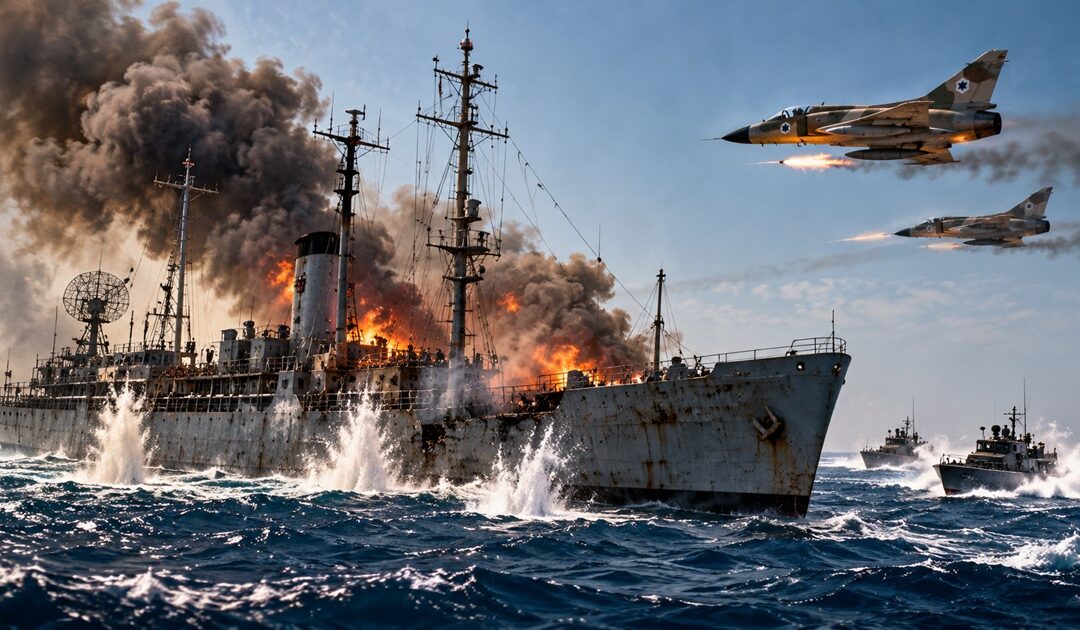
At around 1400 local time on June 8, Israeli reconnaissance aircraft spotted the Liberty and reported its position. Roughly two hours later, Israeli Mirage and Mystere jets hit the ship with cannon fire and napalm, followed minutes later by a second wave firing rockets. As fires spread through the superstructure, three Israeli torpedo boats closed in and fired five torpedoes. One struck near the ship's intercept spaces, tearing a hole close to 40 feet wide below the waterline and killing 25 men instantly, most of them the intelligence specialists working the collection positions.
The assault lasted about seventy-five minutes. When it stopped, 34 American sailors were dead and 171 wounded out of a crew of 294. Captain William McGonagle, wounded himself, stayed on the bridge through the night and kept the ship afloat long enough to reach help. He was later awarded the Medal of Honor, though it was presented at the Washington Navy Yard rather than the White House, a break from custom that survivors and historians have long read as a sign of how quietly the administration wanted the episode handled.
Israel apologized within days, called the attack a case of mistaken identity, and eventually paid compensation to the U.S. government and to the families of the dead and wounded. The Navy Court of Inquiry, convened less than two weeks after the attack and criticized ever since for the speed of its work, reached the same finding: an accident, produced by the fog of war. More than fifty years of declassification have not settled the argument.
Why the Warning Never Arrived
The part of this story that belongs most clearly to intelligence and command history is not the attack itself but the communications failure that came before it. In the days leading up to June 8, naval commanders had grown uneasy about a lightly armed SIGINT ship sitting so close to an active war zone, and the Joint Chiefs of Staff sent an order for the Liberty to move at least 100 miles offshore.
That order never reached the ship. Navy message routing in 1967 ran through a patchwork of relay stations, and the withdrawal order was misrouted several times, sent to the wrong addressees, delayed in transmission queues, and at one point routed through a relay station in the Philippines instead of straight to the Sixth Fleet. By the time anyone caught the error, the attack had already happened. A separate warning, sent hours earlier with a lower precedence marking than the situation called for, sat unread in a message queue for more than sixteen hours.
This was not one clerk's mistake. It was a structural weakness in how urgent tactical warnings moved through a communications system that kept Navy operational traffic and NSA reporting channels on separate tracks. The Liberty existed to solve exactly this kind of delay for other commands. Its own chain of command could not solve it in time for the Liberty.
What the Signals Intelligence Record Shows
The center of the intelligence controversy is a set of intercepts recorded by an Army listening post on Cyprus and by nearby aircraft, capturing Israeli pilots, torpedo boat crews, and their controllers talking during and just after the attack. First referenced publicly in the 1970s, these recordings were released in fuller form by the NSA in 2003 after a Freedom of Information Act lawsuit brought by historian A. Jay Cristol.
Cristol's 2002 book, The Liberty Incident, argued the attack was accidental, and he said the newly released material supported that conclusion. Other researchers who studied the same transcripts read them differently. Journalist James Bamford, in Body of Secrets, pointed to exchanges in which Israeli aircrew appear to note an American flag on the ship before continuing their run. A 2003 review led by retired Admiral Thomas Moorer, a former Chairman of the Joint Chiefs, found the attack deliberate. Every official U.S. government inquiry, including the Navy Court of Inquiry, a CIA assessment, and a later Defense Intelligence Agency review, found the opposite.
An NSA cryptologic history of the incident, written in 1981 and declassified in stages during 2003 and 2007, adds detail without resolving the dispute. It documents real confusion inside Israeli command channels about which vessel they were engaging, including a period in which Israeli intelligence believed an Egyptian supply ship, the El Quseir, was operating in the area and may have been mistaken for the Liberty. Internal NSA memoranda from the weeks after the attack, since declassified, record that agency analysts searching for direct signals intelligence on the attack itself came up largely empty. One memo dated June 27, 1967, states that no SIGINT bearing on the Liberty had been reported since weeks earlier, a gap that reads as suspicious to one camp and as simple absence of evidence to the other.
What the declassified record does establish, and what few historians on either side dispute, is that Israeli reconnaissance aircraft photographed and circled the Liberty for hours before the attack, at low altitude and close range, in conditions clear enough to read hull markings, and that the ship was flying a large American flag. Whether that combination amounts to certain identification or to a tragic failure of interpretation under wartime pressure is where the argument still lives, and no remaining classified file is likely to close it. The NSA has told federal courts it released everything it held on the incident. Researchers who reject the accident finding note that everything the NSA held is not the same as everything any agency produced, and that Israeli military archives on the attack remain far less accessible than the American ones.
Cover-Up, or Cold War Habit
Whatever happened over the Sinai that afternoon, the aftermath followed a pattern familiar to intelligence historians: fast conclusions, thin public explanations, and files that stayed sealed for decades. President Johnson's decision to recall Sixth Fleet aircraft that had launched to defend the Liberty, twice, has drawn nearly as much scrutiny as the attack itself. Officers who served under Vice Admiral William Martin have said under oath that Johnson personally ordered the recall, reportedly because he did not want American carrier aircraft engaging Israeli forces in a war Washington had chosen to stay out of. Declassified State Department cable traffic in the Foreign Relations of the United States series confirms that senior officials, including Secretary of Defense Robert McNamara, were directly involved in pulling back the rescue mission while the ship was still burning, though the full reasoning behind that call remains more interpreted than documented.
The Navy Court of Inquiry took testimony for about a week and issued its finding within a month, an unusually fast timeline for a case that killed 34 Americans. Survivors have said for decades they were discouraged, and in some cases directly ordered, from discussing the attack. Whether that reflects a genuine cover-up of Israeli intent or the standard Cold War reflex to bury an embarrassing allied incident before it complicated a fragile relationship is a question historians answer differently depending on which file they weight most heavily.
What is not in dispute is the strategic logic shaping the American response. By 1967, Israel had become a valued intelligence and political partner against Soviet influence in the region. A public finding of deliberate attack on a U.S. Navy vessel would have forced a diplomatic reckoning that Johnson's administration, already consumed by Vietnam, had no appetite for. That context does not prove intent behind the fast inquiry. It does explain why an accident finding was the outcome Washington needed, regardless of what the evidence showed.
The Intelligence Lessons That Outlasted the Argument
Set the dispute over Israeli intent aside, and the Liberty case still stands as one of the clearer cautionary tales in the history of American SIGINT operations.
The first lesson concerned message handling. The failure to deliver the Joint Chiefs' withdrawal order led directly to a rebuild of Navy message procedures, with stricter rules on how urgent fleet-movement orders were flagged, routed, and confirmed received. The seizure of the USS Pueblo by North Korea seven months later, in January 1968, reinforced the point hard: unarmed SIGINT ships operating near active conflict zones needed better protection or faster warning channels. Within a few years the Navy pulled its technical research ships out of forward collection work, shifting that mission toward aircraft and, eventually, satellites, platforms far less exposed to a close-range attack.
The second lesson concerned command structure. The Liberty operated under a split arrangement, Navy operational control on one side and NSA tasking authority on the other, a division that made administrative sense but created exactly the kind of gap that let a critical warning disappear into the wrong queue. Later SIGINT platforms were built with more direct, single-line command relationships specifically to keep that failure from repeating.
The third lesson is less about procedure and more about the limits of declassification itself. More than fifty years of FOIA lawsuits, congressional requests, and voluntary NSA releases have produced thousands of pages on the Liberty attack, and the core factual dispute over intent still has not closed. That is a genuine warning against assuming that enough declassified paper eventually settles a contested intelligence event. Sometimes the paper runs out before the argument does, and what is left is a set of documents that careful readers, working from the same primary sources, use to reach opposite conclusions.
What Remains
Thirty-four names are inscribed on the USS Liberty memorial in Arlington National Cemetery. Survivors' associations still hold annual reunions and still push, through FOIA requests and letters to Congress, for further declassification, especially of Israeli military records that have never been opened the way the American files eventually were. The Israeli government has never reopened its own 1967 inquiry, which cleared its forces of wrongdoing, despite decades of pressure from American veterans' groups and members of Congress.
For students of intelligence history, the value of the Liberty case is not that it proves a conspiracy or confirms an accident. It is that a documentary record now about as complete as it will ever get still cannot force agreement between honest readers working from the same evidence. That is an uncomfortable place for an intelligence case study to land, and it is exactly where this one sits, more than half a century after a torpedo tore through the side of an American ship that had been built to listen and, for one afternoon in June 1967, could not warn even itself.