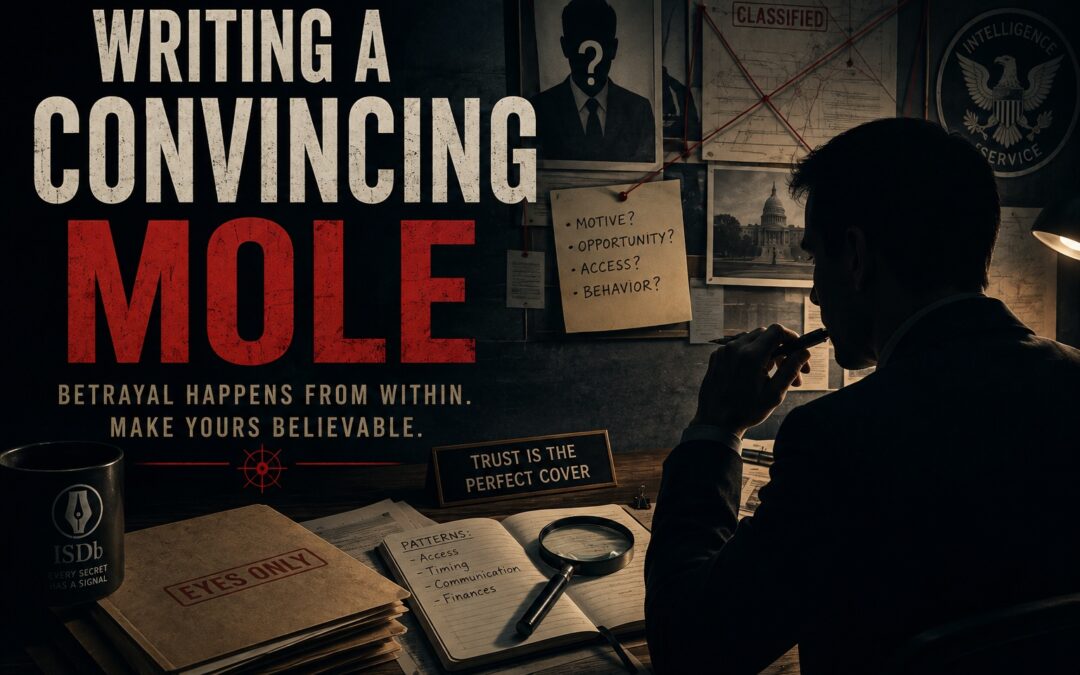
Few characters are more at home in espionage fiction than the mole.
A mole sits inside an intelligence service, government agency, military organization, corporation, or other institution while secretly serving an adversary. Unlike the outside spy trying to penetrate a secure organization, the mole already possesses what the adversary wants most: access.
That makes the mole extraordinarily useful to an intelligence service.
It also makes the mole extraordinarily useful to a novelist.
A well-written mole creates two stories simultaneously. The first is the visible intelligence operation. The second is the hidden story occurring inside it. Information disappears. Operations fail. Sources are compromised. Decisions that seemed reasonable produce disastrous results.
Somewhere inside the organization, someone knows why.
The challenge for the writer is making that person convincing.
The Mole Must Have a Reason
The weakest fictional mole betrays his country because the plot requires a traitor.
Real betrayal is usually more complicated.
Intelligence professionals have traditionally discussed motivations for espionage using variations of the acronym MICE:
Money. Ideology. Compromise. Ego.
The categories are useful, but human motivation rarely fits neatly into one box.
A person may begin spying for money and continue because of resentment. Another may believe sincerely in an ideology when recruited and later remain trapped because exposure would destroy a career and family. Someone motivated by ego may eventually convince himself that his actions are ideological.
The novelist should therefore ask a more interesting question than Why did this person become a mole?
Ask:
Why does this person continue?
The answer may change over the course of the story.
That change creates character.
Money Is More Complicated Than Greed
Money seems like the easiest motivation to write.
It isn't.
Simply making a character greedy rarely produces a memorable traitor. The more interesting question is why money matters so much to this particular person.
Debt can create desperation. Expensive tastes can create vulnerability. Financial resentment can become a measure of perceived injustice.
A character might think:
They trust me with secrets that can change governments, yet they pay me less than a corporate lawyer.
The money then represents more than purchasing power.
It represents recognition.
Once you understand what the payment means to the character, the betrayal becomes more convincing.
Ideology Produces Powerful Moles
An ideological mole does not necessarily believe he is a traitor.
He may believe everyone else is wrong.
That distinction matters.
The history of espionage provides numerous examples of people who passed secrets because they believed they were serving a greater political or moral cause. To them, loyalty to an idea could supersede loyalty to a government.
That gives the novelist enormous possibilities.
An ideological mole can remain sympathetic while doing terrible damage. He can be intelligent, courageous, disciplined, even personally honorable.
He simply serves a different truth.
The best version of this character should occasionally make the reader uncomfortable by making a persuasive argument.
If his beliefs are obviously ridiculous, the moral conflict disappears.
Ego May Be the Most Interesting Motivation
Never underestimate the intelligence officer who believes he is smarter than everyone around him.
Espionage organizations necessarily place enormous value on information. People inside those organizations understand exactly how valuable their access is.
But institutional recognition rarely matches an individual's opinion of his own importance.
Promotions are missed.
Prestigious assignments go to someone else.
Supervisors fail to recognize brilliance.
Colleagues receive credit.
Resentment accumulates.
Then someone from another intelligence service arrives and delivers precisely what the institution has withheld:
Respect.
Suddenly the overlooked employee is important. His opinions matter. His information is valuable. Someone is waiting to hear what he has to say.
Money may accompany the relationship, but recognition can be the real payment.
For a novelist, that is fertile ground.
Compromise Creates a Different Kind of Character
The compromised mole begins with coercion.
Perhaps an intelligence service possesses evidence of criminal conduct, corruption, an affair, concealed finances, or some other secret capable of destroying the target's life.
The obvious fictional progression is:
Give us information or we expose you.
That works, but it is only the beginning.
The more interesting story concerns what happens afterward.
A reluctant source can gradually become cooperative. Fear can become routine. Routine can become rationalization.
Eventually the character may stop thinking of himself as a victim.
That transformation can be more disturbing than the original blackmail.
Give the Mole Something Worth Stealing
A mole is only as important as his access.
This is one of the easiest mistakes to make in espionage fiction.
Writers sometimes place a traitor inside an intelligence organization and then allow that character to know virtually everything the organization knows.
Real institutions compartment information.
An analyst may have extraordinary access to one category of intelligence and almost none to another. A technical specialist might understand a collection system but know little about human sources. A senior official may see broad strategic reporting without knowing the operational details behind it.
Access should therefore be designed deliberately.
Ask four questions:
What can the mole legitimately see?
What can the mole obtain with some effort?
What can the mole not access?
What would immediately look suspicious if the mole tried to obtain it?
The last question is particularly useful.
It creates boundaries.
And boundaries create suspense.
Don't Make Your Mole Omnipotent
A mole should be dangerous.
He should not be magical.
If every operation fails, every source dies, every secret reaches the enemy, and every investigation is effortlessly defeated, readers will eventually stop believing in the institution surrounding him.
The best mole operates under constraints.
He cannot always communicate safely.
He may receive information too late.
He may misunderstand something.
He may deliberately withhold intelligence from his handler because providing it would expose him.
That last possibility is especially important.
The mole's first priority eventually may not be helping the adversary.
It may be protecting himself.
Now the relationship between mole and handler becomes a negotiation.
The handler wants more.
The mole wants to survive.
That tension can drive an entire novel.
The Mole Needs a Normal Life
Your mole probably does not spend twenty-four hours a day betraying national secrets.
He attends meetings.
He complains about paperwork.
He eats lunch with colleagues.
He has friends.
Perhaps a spouse and children.
He may coach a soccer team, collect antique maps, argue about baseball, or worry about an aging parent.
Those details are not filler.
They create camouflage.
More importantly, they force the writer to confront the psychological reality of betrayal.
The colleague whose source the mole has just compromised may sit beside him at lunch the following afternoon.
What does he say?
Can he look at him?
Does he feel guilt?
Or has he become so skilled at compartmentalization that the two events occupy entirely different parts of his mind?
That is where the character becomes interesting.
Betrayal Should Have Consequences
Information is abstract until something happens because of it.
A stolen document is not inherently dramatic.
What happens because the document was stolen is dramatic.
An operation is compromised.
An agent disappears.
A surveillance capability is neutralized.
An adversary changes communications systems.
A diplomatic initiative collapses.
A military capability is exposed.
Someone dies.
The writer does not necessarily need spectacular consequences. Sometimes a small operational failure is more believable and ultimately more revealing.
But there should be a chain:
Access → betrayal → adversary action → consequence.
If the reader can eventually reconstruct that chain, the mole plot feels earned.
Leave Evidence
A convincing mole mystery must be solvable.
That does not mean it should be obvious.
The writer should leave anomalies.
Perhaps a compromised operation had only six people read into it.
Perhaps an adversary suddenly stopped using a communications channel shortly after an internal briefing.
Perhaps several lost assets share one administrative connection.
Perhaps information appears to have leaked before it reached senior leadership.
Perhaps the enemy knows something it should not know while conspicuously failing to act on something else.
That last clue can be particularly powerful.
Counterintelligence is not merely asking:
What does the enemy know?
It is also asking:
How could they know it?
Eventually patterns emerge.
Let the Investigation Be Wrong
Real counterintelligence investigations do not proceed in perfect straight lines.
Neither should fictional ones.
An innocent officer may appear suspicious.
A genuine security violation may have nothing to do with the mole.
Someone may lie during an interview because he is hiding something completely unrelated.
A suspicious financial transaction may have an innocent explanation.
These complications accomplish two things.
They prevent the investigation from becoming mechanical, and they create consequences for suspicion itself.
Counterintelligence can damage innocent people.
That gives the investigation moral weight.
Remember the Handler
A mole story actually involves at least two principal characters.
The mole is one.
The handler is the other.
Someone recruited the source, communicates with him, evaluates his information, protects him, pressures him, and reports what he produces.
The relationship between them can become one of the richest parts of the story.
Does the handler genuinely care about the mole?
Does the mole believe he does?
Are they friends?
Can intelligence officers and their sources ever truly be friends?
The relationship contains an unavoidable contradiction.
The handler's job is to protect the source.
The handler's job is also to persuade the source to continue doing something that could destroy his life.
That contradiction deserves attention.
Communication Is a Vulnerability
The mole possesses information.
The adversary needs to receive it.
Between those two facts lies one of the central problems of espionage.
Communication creates exposure.
Meetings can be surveilled. Electronic communications can be intercepted. Dead drops can be discovered. Patterns can be detected.
For fiction, this is extremely useful because communication forces the mole to act.
Until that moment, betrayal can remain inside an office or computer system.
Once information must be transferred, the mole enters the physical world of tradecraft.
The writer gains surveillance, countersurveillance, dead drops, covert communications, clandestine meetings, and operational mistakes.
The mole suddenly becomes vulnerable.
The Mole Hunt Should Narrow Access
One of the pleasures of a good mole story is watching an enormous institution gradually become a small room.
At first, anyone could be responsible.
Then investigators determine that the compromised information came from a particular operation.
Twenty-seven people had access.
Another compromise reduces the overlap to twelve.
A third leaves five.
Now everyone knows everyone.
They may have worked together for years.
That is when counterintelligence becomes personal.
The investigator is no longer hunting an abstraction called "the mole."
He is investigating colleagues.
Perhaps friends.
Perhaps a mentor.
Perhaps the person who taught him how to conduct counterintelligence investigations in the first place.
Don't Make the Mole Look Like a Villain
The mysterious employee who never socializes, keeps strange hours, asks suspicious questions, and stares ominously across conference tables is unlikely to survive very long inside a security-conscious organization.
A successful mole should look trustworthy.
Perhaps exceptionally trustworthy.
He may be competent, helpful, and respected.
He may have excellent security habits because poor ones would attract attention.
He might even participate in the mole investigation.
That is not merely a convenient fictional device. It creates the central irony of counterintelligence:
The institution must trust people in order to function.
The mole weaponizes that trust.
Give the Mole Something to Lose
Capture alone is not enough.
Give the character a life worth protecting.
A marriage.
Children.
A career.
Professional reputation.
Friendships.
A cause.
Perhaps even genuine affection for the institution he is betraying.
That apparent contradiction is entirely possible.
People are capable of holding incompatible loyalties.
A mole may admire his colleagues while betraying their operations. He may love his country while convincing himself its government has lost its way. He may despise the intelligence service he works for while desperately wanting its respect.
Contradiction makes him human.
Decide When the Reader Should Know
There are two fundamentally different mole stories.
In the first, the reader does not know the mole's identity.
The novel becomes a counterintelligence mystery.
In the second, the reader knows exactly who the mole is.
Now the suspense comes from watching investigators get closer.
Both approaches work.
But they produce different experiences.
If you conceal the identity, clues and fair misdirection become essential.
If you reveal the identity, psychology and operational suspense become more important. The reader watches the mole enter meetings with the very people hunting him and understands the significance of every question.
There is also a third possibility.
Reveal the mole halfway through.
The first half asks:
Who is it?
The second asks:
Will they catch him?
That structure can be extremely effective.
The Best Mole May Believe He Is the Hero
A convincing mole should be able to explain himself.
Not necessarily excuse himself.
Explain himself.
Give him the opportunity, even if only internally, to make the case for what he has done.
Perhaps his government betrayed its principles.
Perhaps his superiors sacrificed people unnecessarily.
Perhaps another country represents the political system he genuinely believes in.
Perhaps he thinks two nuclear powers need strategic balance.
Perhaps he believes the secrets he passed prevented a war.
Perhaps he simply believes that an institution foolish enough not to recognize his value deserves his betrayal.
The reader does not have to agree.
The reader only has to believe that he agrees.
That distinction separates a character from a plot device.
The Real Secret of Writing a Mole
The mechanics matter.
Access matters.
Tradecraft matters.
Compartmentation matters.
Counterintelligence procedures matter.
But none of those things creates a memorable mole by itself.
Betrayal is ultimately a relationship.
The mole betrays an institution composed of people who trusted him.
That is why the greatest mole stories remain compelling long after the operational details have become outdated.
The technology changes.
The communications change.
The geopolitical adversaries change.
Human trust does not.
And somewhere inside every successful mole story is the same disturbing realization:
The enemy did not break through the door.
Someone opened it.
Alexander Hale
Intelligence Editor, ISDb — The Intelligence & Spy Database
Continue Your Discovery.