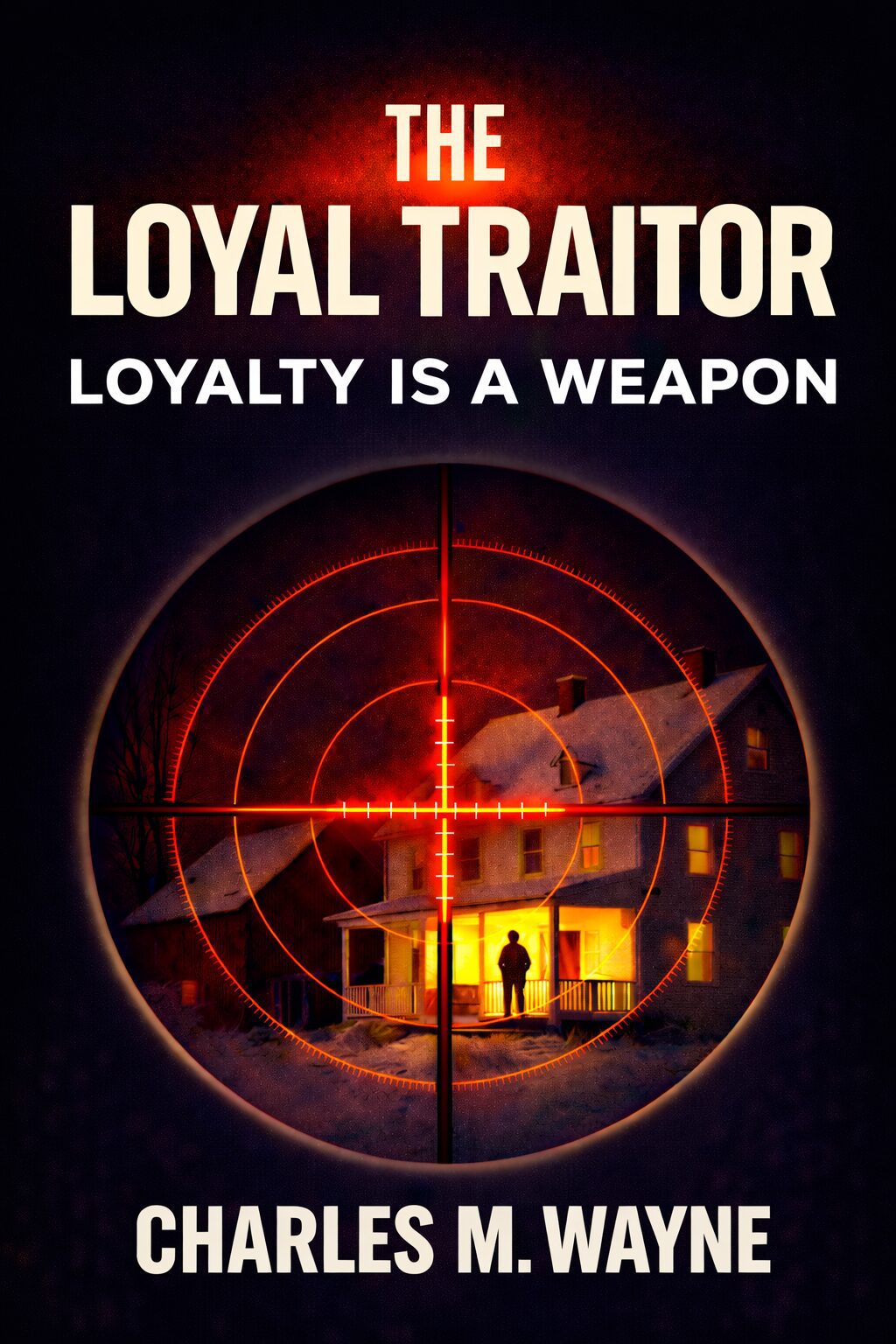
The Loyal Traitor
An Espionage Techno-Thriller
When Shen Ke—long thought dead—reappears as "Andrew Chan," the U.S. Army’s counterintelligence command must hold a lie that could remake global power. Under the camouflage of a rural Vermont farmhouse called Nusquam, they shelter a genius who built a fragile, dangerous quantum machine: Echo Reef. But quiet is a poor defense. Passive satellite taps, a buried cicada-style recruitment engine called Chrysalis, and an assassin’s glint on the ridge all conspire to turn secrecy into a kill-list.
Major Will Morgan’s Watchtower team threads together SIGINT, operatives, and an improbable set of misfits—an Asperger savant, a retired working-dog, and a physicist who once deceived two nations—to protect the machine and the ghosts tied to it. As state actors compete for ownership of the future, the lines between protector and traitor blur, and the only certainty is the timetable: they must keep Echo Reef alive long enough to prove a lie wrong without becoming the story the world will retell.
Supermax
Sometimes truth was what it needed to be. Sometimes only deception endured.
Florence, Colorado - ADX Supermax
The Supermax prison in Florence, Colorado—officially known as the United States Penitentiary Administrative Maximum Facility (USP Florence ADMAX) or simply ADX Florence—was the most secure federal prison in the U.S. It was designed for the most dangerous federal inmates, including terrorists, organized crime leaders, violent criminals, and spies.
Transfer Bay - 0110 Hours Tango
Steel gates screech open as a blacked-out U.S. Marshals van rolled into the secure underground intake. A coded alert pinged quietly across the internal security system: INMATE CATILINE - LEVEL 6 - SAM RESTRICTED.
Shen Ke, still wearing Bureau-issued restraints and black hood, was escorted by a heavily armed five-man Convict Movement Team (CMT). A supervisor from the Federal Bureau of Prisons confirmed the identity with biometrics, voiceprint, and retinal scan. There were no verbal exchanges permitted—Shen’s SAM protocol had already begun.
Admissions And Orientation Holding Area
Shen was brought into a sanitized, all-white intake room. Under Special Administrative Measures (SAMs)—his interaction was limited to one pre-cleared intake officer who read from a script. No questions were asked or answered.
He was strip-searched under full-body scanner. Tattoos were scanned and logged. DNA sample verified against the DOJ’s covert detainee database.
His few personal items—a cheap pen, one notepad with thermochromic ink, a pair of prison-issue glasses—are bagged, documented, and later shredded under the Special Evidence Disposal Order.
H-Unit Secure Corridor
The H-Unit was the deepest tier—built to house terrorists, traitors, and those deemed counterintelligence threats.
Codename: CATILINE was assigned to Shen’s cell block—a nod to the Roman figure who waged clandestine war against the republic.
As the biometric door opened, dual overhead motion sensors activated. Shen was taken through a series of four sally ports, each required two independent operators to authorize passage.
Each step was recorded, logged, and timestamped.
Shen was locked in a sound-dampened cell.
- 4-inch-thick plexiglass over steel bars.
- No paper books allowed—only encrypted e-reader with redacted content.
A wall-mounted camera recorded every breath. Audio monitored 24/7 by a dual team from DOJ and FBI Behavioral Threat Assessment Unit.
Cell 42 - 0317 Hours Tango
The corridor was silent—silent in the way that only concrete and steel can make silence oppressive.
Camera feeds looped a thirty-second buffer of empty hallway. Cell 42-A was marked for "routine inspection." But nothing was routine tonight.
The man inside the cell sat motionless on the edge of the concrete bed, dressed in the standard khaki jumpsuit, his thin fingers curled over his knees.
The lights buzzed overhead. He blinked slowly, as if emerging from a long fog. He didn’t stand when the outer door clicked.
The hatch opened.
Two men entered without speaking. Their uniforms were generic black—no rank, no insignia. One carried a biometric override panel. The other, a tightly sealed duffel.
The first guard scanned a palm print, followed by a retinal check on the prisoner. A pause. A chirp. Green light. The cell door disengaged.
"Mr. Ke," one of them said softly.
He looked up slowly. “It’s time?”
“Yes. You’ll be pronounced dead at 08:14 from a brain aneurysm. Autopsy will be sealed. Body will be cremated.”
He nodded once. The charade had been expected. Every man in his position knew death was the only way out.
They moved quickly. Clothes were swapped: civilian layers over a black thermal base. Beard trimmed. Contacts in. A minor prosthetic applied to break the facial profile.
Down the hall, two orderlies wheeled a covered stretcher. They passed two checkpoints, flashing fabricated incident reports and medical memos from a fake Bureau of Prisons physician.
The body under the sheet wasn't Shen. Swapped under executive authorization.
It was a John Doe from ADX’s morgue—a lifer with no living family, no visitors and a matching blood type. The kind of man who vanished without questions.
Shen Ke followed his escort to the service elevator. No cameras on this shaft. It was designed for food delivery and body disposal—either worked, in this case.
Below, a tunnel. Sealed during construction. Denied in records. Air smelled of rust, water, old copper. It led beneath the bluff to an unmarked service garage where a white utility van idled. No logos. Wyoming plates. Winter-dirty.
Inside waited a woman. Compact frame, gray field jacket, clipboard. She did not introduce herself.
"You're in the system as dead. Chinese surveillance chatter has already picked up the autopsy report. The leak was intentional. They’re mourning a hero."
He didn’t speak. The look in his eyes was unreadable. Regret? Relief? A double life offered no clean emotion.
The van rolled out just before shift change. No spotlight tracked it. No drone followed. No one on duty would remember it ever arrived.
For many the truth is merely what it needs to be.
* * *
Three Weeks Later Rural Vermont, deep winter.
The plan was simple in structure, complex in execution. A farmhouse tucked in the folds of misty pines. No neighbors for miles. A single phone line. Satellite uplink buried under snow. An unremarkable facility on the outside in the Vermont hills—spare, rural. A ‘mini Area 51’ hidden in plain sight. Inside: Nusquam. A quantum computer lab, designed and programmed by Shen dedicated solely to military applications.”
Inside, Shen Ke—now "Andrew Chan"—sat near a fire, reading a worn paperback in Cantonese.
Outside, the snow fell thick and soundless.
* * *
In Beijing, a brass memorial was commissioned in his honor. In Washington, his name was erased from every operation he ever touched. And in the quiet of the Vermont woods, the man with no name waited—watching the world he had betrayed and protected from the same distance, with the same precision, for which he had always been trusted.
* * *
The car sat alone at the edge of the small gravel lot, engine off, headlights dark, positioned so it looked like nothing more than an early arrival waiting for the day to begin. Frost clung to the edges of the windshield. The mountains were still silhouettes. Eight and a half miles away, Nusquam slept.
Inside the vehicle, he waited without fidgeting, hands resting lightly on the steering wheel, breath slow and measured. Anyone passing would have seen a man killing time before the post office opened—nothing more.
He reached into his jacket and produced a small, palm-sized device, matte black, unmarked. His thumb pressed a recessed button. There was no sound, no vibration. After a brief pause, a single green light appeared. Live. He watched it for a heartbeat longer than necessary, then powered it down and slipped it back into an inner pocket.
Next came the briefcase. It opened quietly on his lap. From it he removed a device no larger than a cigar box, heavier than it looked. He set it on the passenger seat and switched it on. Five amber lights came alive, rotating in a precise sequence—one, two, three, four, five—cycling again and again. He did not stare at them; he glanced, checked the rhythm, the timing, the absence of deviation. After roughly a minute, satisfied, he shut it down, returned it to the case, and closed the latch.
Stillness again.
When the post office lights flickered on and the door unlocked, he stepped out of the car and joined the role he had been playing all along. Inside, he moved with unhurried purpose. A single envelope appeared from his coat. He chose the out-of-town slot set into the wall, angling his body just enough so the security camera caught only the side of his head, never his face. The letter slid in. No pause. No correction.
Moments later, he was gone.
The car pulled out smoothly, tires crunching softly on gravel, merging onto the road without haste. Within seconds it blended into the Vermont morning, leaving behind nothing but an ordinary errand completed—and no reason at all to remember who had done it.
Chapter Two
Echo Reef
Operation Echo Reef
Arlington, VA - DARPA Headquarters - 0930 Hours R
The room was already hot with disagreement when Helena Quinn stopped pacing and let the silence stretch.
The Director of the Defense Advanced Research Projects Agency (DARPA)—“the Pentagon’s brain”—took the floor. Across from her had sat Major General Owen Edwards, commander of the Army Intelligence and Security Command (INSCOM), and Brigadier General Ed Perry commander of the Army Counterintelligence Command (ACIC). At Perry’s side was Major Will Morgan, his presence unusual for such a senior gathering. He had not even been back to Fort Meade yet from his presidential mandated month leave. Helena had insisted. She didn’t want her message filtered through ranks or watered down in a memo. Morgan’s team Watchtower would inherit Nusquam; their commander needed the unvarnished truth.
Helena carried authority like a tailored suit—unassuming, but impossible to miss. Her words were precise, each pause intentional, the kind that made even generals lean forward.
“Nusquam exists,” she said finally. “Not as a concept. Not as a white paper. It’s operational. And if we mishandle it, we won’t get a second chance.”
Owen Edwards leaned back in his chair, arms folded, jaw tight. “That’s exactly the problem, Director Quinn. Everyone in this room has been told it’s operational. We’ve also been told it’s revolutionary, transformational, and existentially important. But every time we ask what it actually does—what it delivers in practical, defensible terms—we get metaphors.”
A few heads nodded around the table.
Helena met his gaze. “Because the underlying science doesn’t map cleanly to twentieth-century acquisition language.”
“That’s not an answer,” Owen shot back. “That’s a warning sign. We’re being asked to protect facilities we can’t fully explain, fund programs we can’t benchmark, and prioritize threats we can’t quantify. Every black project in this building claims it’s the hinge point of the future.”
She stepped closer to the table, palms flat on the polished wood. “Nusquam is different.”
“You say that about all your new programs,” Owen replied evenly. “Until the next one.”
“Here’s the part we can explain,” she said. “Nusquam changes the confidence level of everything upstream—sensors, prediction models, command decisions. It doesn’t give you a weapon. It gives you truth density—a satellite photo where every decoy tank is circled in red before you even know to look for them." ”
Owen exhaled through his nose. “Truth density isn’t a line item.”
“No,” Helena agreed. “But survivability is. Decision advantage is. Strategic surprise—or the lack of it—is.”
He leaned forward now. “And how do we defend that in a budget hearing? When a senator asks why Nusquam gets priority over missile defense, cyber, hypersonics? When they ask why a farm in Vermont needs more protection than a carrier group?”
Helena didn’t hesitate. “Because Nusquam is the thing that tells you whether the missile warning is real. Whether the cyber intrusion is noise or preparation. Whether the hypersonic launch is a bluff or a first strike.”
The room went quiet again—this time, heavier.
Owen tapped his pen once against the table. “You’re asking us to fund an oracle.”
“I’m asking you to fund the protection of epistemic advantage,” she said.
“And if it fails?” someone down the table asked.
Helena turned. “Then we lose money.”
Owen sat back again, quieter now. “You understand the bind you’re putting us in.”
“I do,” she said. “But obscurity doesn’t make Nusquam less real. It just makes it easier to kill with spreadsheets.”
The chair at the end of the table creaked as someone shifted.
Owen nodded once, reluctantly. “Then we need a new priority framework.”
Helena allowed herself a thin smile. “That’s why you’re here.”
The screen behind her went dark.
“And that,” she added, “is why Nusquam stays alive.”
“It’s time Army Intelligence—especially Counterintelligence—comes fully inside the loop on Operation Echo Reef,” she began.
Her voice was calm, but the weight of her words pressed on the room.
The lights dimmed until the room was little more than silhouettes as the soft, surgical hum of the smart-wall powered up. The first slide glowed to life: Quantum Defense Applications. The DARPA Director, architect of the improbable—began.
“Generals,” she said calmly, “this morning I’m not here to explain quantum computing.”
She clicked the remote.
The wall behind her erupted into a lattice of swirling interference patterns.
“I’m here to show you.”
General Edwards and General Perry exchanged a glance—uneasy, intrigued. Major Will Morgan leaned forward slightly, gaze sharpening.
Helena gestured toward the display.
“This is the Nusquam prototype—ECHORITHM. Nemo’s machine. Fragile, temperamental, and powerful in ways classical computation can’t imitate.”
She tapped the control.
The lattice collapsed into a 64-digit encrypted key, glowing in icy blue.
“First demonstration. Watch closely.”
She divided the wall into two halves:
Left: a standard Army-grade brute-force cracking simulation
Right: ECHORITHM quantum factoring module
“General Edwards,” Helena said, “how long would INSCOM estimate to break a key of this size with classical resources?”
Edwards grunted. “Decades. Maybe longer. Could require a cluster the size of Fort Meade.”
“Correct.” Helena nodded.
The left simulation began churning—slowly, painfully—counters climbing toward infinity.
“Now, quantum.”
The right side pulsed.
Then blinked.
Then displayed:
KEY FACTORED—0.0042 SECONDS
Edwards sat back as if someone had punched the air out of him.
Perry’s jaw tightened.
Will didn’t move, but his stillness was sharper now—like a knife laid flat.
Helena turned to them. “This is not a faster crowbar. It’s a master key.”
She didn’t let the silence settle.
“Second demonstration.”
The screen went blank except for a live feed: a swirling chaos of propaganda posts, synthetic media, fake accounts, all harvested from an adversary botnet during the last six hours.
“This,” Helena said, “is the information battlespace you deal with daily. Millions of voices—real, fake, weaponized—indistinguishable.”
The generals nodded.
Helena tapped again.
A second stream appeared beside it—the same data, but now quantum-analyzed.
In the blink of an eye, the fog cleared.
Bots glowed red.
Synthetic video signatures pulsed violet.
GAN faces detached from their background vectors.
Russian, Chinese, and proxy narratives braided into visible strands of manipulation.
The room went quiet.
Helena stepped aside so they could see the two screens fully—chaos on one side, clarity on the other.
“A flashlight versus sunlight,” she said softly.
“We’ve been walking through fog for twenty years. Quantum turns the fog into glass.”
Perry leaned forward. “Show me something offensive, Helena.”
She studied him for a heartbeat, then obliged.
The screen shifted to a satellite map over the South China Sea.
Shipping lanes. Buoys. AIS beacons. Military patrol paths.
“This is real-time quantum signal inference. The prototype can detect spoofed satellite positions, naval ghost routes, and hidden vessels by analyzing electrical noise patterns that classical sensors treat as background static.”
She highlighted a section of open water.
A moment later, a submerged submarine silhouette appeared—one not listed in any U.S. or allied database.
Edwards stiffened. “We didn’t know that was there.”
“No,” Helena said. “But ECHORITHM did.”
Will spoke quietly, but the words carried.
“With this… every deception becomes visible.”
Helena nodded.
“And if an adversary gets there first?” Perry asked.
Helena’s expression hardened.
“Then we become visible. Every classified briefing. Every nuclear command handshake. Every covert network. Every operation you’ve ever buried under three layers of clearance.”
She clicked again.
Helena let the last image fade—the submarine silhouette dissolving into darkness until the briefing room was lit only by the soft amber edge lights.
For a long moment, no one spoke.
Then Helena took a step forward, her voice lowering—not dramatic, not triumphant, but sober.
“There’s one more thing you need to understand before we proceed.”
Perry looked up sharply. “Go on.”
Helena nodded toward the now-dark screen.
“What you saw tonight—the cryptanalytic breakthrough, the disinformation mapping, the deep-sea signal extraction—those were ECHORITHM operating at its best.”
Edwards frowned. “Best?”
“Yes.” She clasped her hands behind her back. “ECHORITHM is still experimental. Its coherence times are short, its qubit consistency uneven, and its error-correction layers… frankly, held together with duct tape and prayer.” A thin, humorless smile. “We are a long way from reliable fidelity.”
Will leaned forward slightly, listening more intently now than during any of the demonstrations.
Helena continued, her tone precise and unvarnished:
“What you witnessed tonight were the instances where it worked.
The good runs.
The lucky collapses of the wavefunction.
The early glimpses of what quantum can eventually achieve at scale.”
Edwards exhaled, the tension shifting in his posture. “So you’re saying these results aren’t dependable.”
“I’m saying,” Helena replied, “that they are directionally inevitable. But today? No—they’re not dependable. Not stable. Not repeatable at will. We get brilliance in flashes. And failure far more often than success.”
She raised her hand slightly.
“For every crisp decryption you saw, we get ten noise-drowned misreads.
For every perfect disinformation mapping, we get phase errors that collapse the dataset.
For every submarine silhouette, we get empty water.”
Will spoke quietly. “But the fact that it works at all means the future is unavoidable.”
Helena nodded once.
“That’s exactly right, Major. ECHORITHM’s imperfections don’t make it less dangerous. They make this moment narrower. Because once coherence stabilizes—once error correction catches up—whoever reaches fidelity first doesn’t just win a race.”
Her gaze swept the room.
“They rewrite the physics of intelligence.”
A beat.
“And everyone else plays catch-up for the next fifty years.”
Perry leaned back, absorbing the full weight of that.
Edwards clasped his hands, eyes narrowed. “So Echo Reef is only our head start.”
“It is,” Helena said. “Our first, fragile foothold on the second floor of the ocean.”
Will rose slowly, the realization settling in him like gravity.
“And Watchtower,” he said, “inherits a machine that can either save the country… or collapse every secret we have.”
Helena didn’t blink.
“That is why you—and only you—get the unfiltered truth.”
Will finally stood, his face unreadable.
“And Team Watchtower,” he said quietly, “inherits this.”
Helena met his gaze. “Yes. You inherit Nusquam. And the future no one is ready for.”
Will leaned back, expression unreadable, then gave a slow nod.
“Understood.”
This is the second book in the Watchtower Series, introducing Team Watchtower—an elite investigative unit within the U.S. Army Counterintelligence Command (ACIC).
Most espionage thrillers revolve around the CIA. However, following the National Defense Authorization Act (NDAA) of 2025, ACIC was formally elevated from a primarily intelligence-focused agency into a hybrid counterintelligence and law enforcement command. This landmark change granted its civilian special agents limited federal arrest authority for national security crimes and expanded its operational scope beyond military installations.
Today, ACIC stands as the only counterintelligence organization with both foreign and domestic jurisdiction—and the legal authority to investigate, detain, and prosecute espionage within and beyond U.S. borders.
Order The Loyal Traitor

EBOOK

AUDIO
When America’s most valuable double agent is declared dead inside Supermax, he is secretly reborn in a hidden quantum research facility where a breakthrough capable of exposing global deception sparks a covert war between intelligence powers.
Schedule an Event
Contact Publisher
publisher@dragonfly.associates
Contact Author
author@spyscribe.com