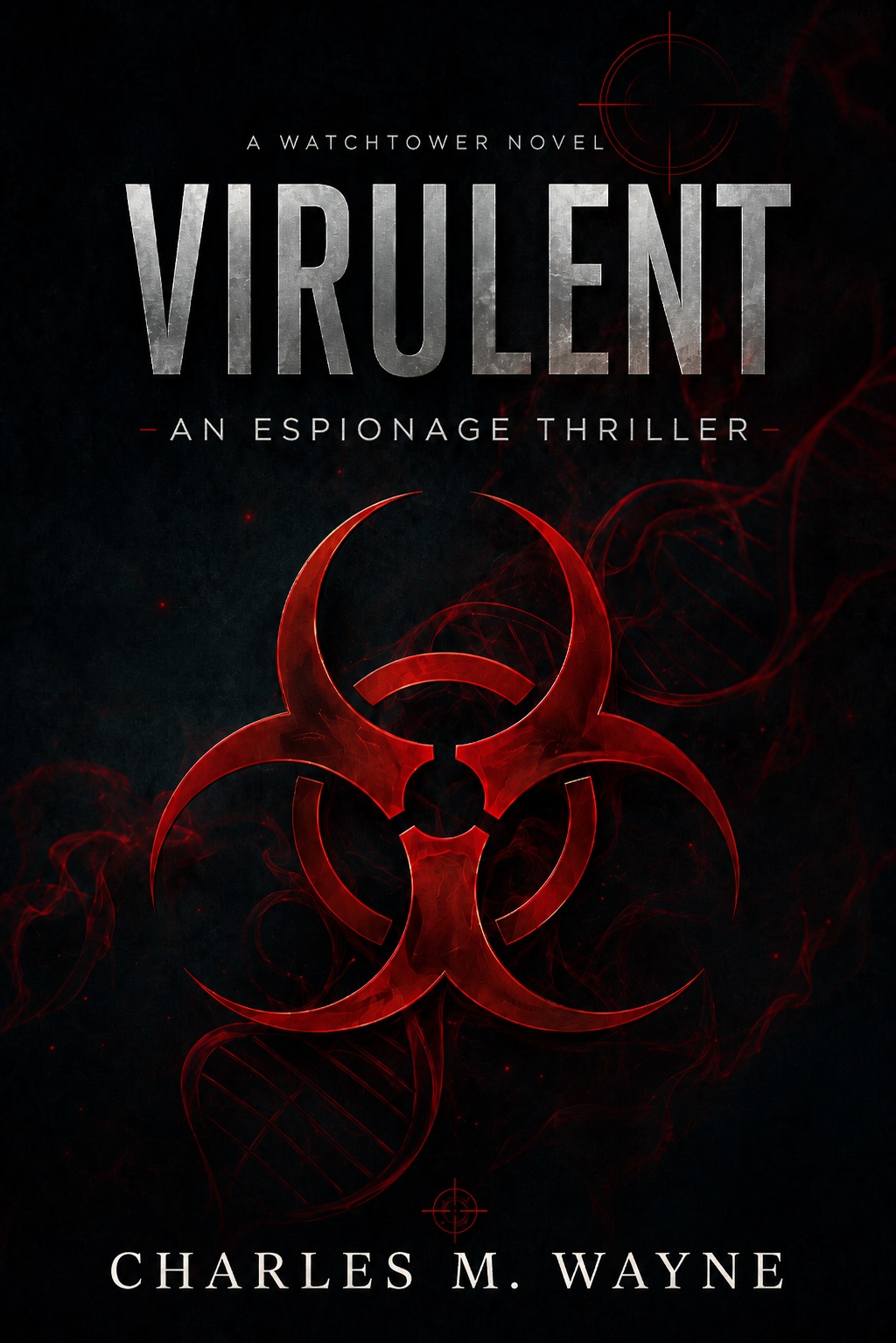
VIRULENT
The Pathogen Deception
An Expionage Techno-Thriller
Major Will Morgan’s Watchtower team is designed to see what others miss—until SYBIL, their classified AI, surfaces a whisper that becomes a scream: Pyongyang is shopping biologicals. What starts as chatter turns into intercepted genomes, shell corporations, and the broker known only as Alhazen. As the team lays bait—decoy reagents, seeded cargo manifests, and a controlled deception that could expose a market—alliances fray: China refuses to be dragged into blame, Iran’s leadership hedges, and Hamas begins to plot with an unexpected supplier.
With every step the moral calculus darkens. Neutralize a shipment and the trail dies; let it pass and a city dies. Morgan must navigate sabotage, diplomatic backchannels, and the lethal vanity of scientists selling secrets. The clock tightens as Mossad, CIA, and shadow brokers circle the same prize—and only Watchtower stands between a market of plagues and a global catastrophe.
“Authentic, intelligent, and gripping — Radiant Sentry delivers the realism of Le Carré with the pulse of Clancy. A modern espionage thriller that feels shockingly real.”
“Finally, a spy thriller where the women aren’t sidekicks — they’re the brilliance driving the mission. Sharp, high-tech, and deeply human.”
“A high-tech espionage thriller with brains, heart, and authenticity. One of the best in years.”
“Feels like living inside a real counterintelligence operation — tense, smart, and impossibly hard to put down.”
Foshan, Guangdong Province — The Lab
The Pearl River Delta lay hushed under a moonless sky, the city glow of Foshan just a smudge on the horizon. Edward Langley moved like a shadow along the perimeter wall of the old biotech facility.
He knew Mossad was on his tail. He’d picked them up three turns back on his abbreviated surveillance detection route. Normally he would have been annoyed at the tail. Tonight, he welcomed it. Safety in numbers, he told himself.
The facility loomed ahead, a relic of China’s fevered biotech expansion in the 1990s. No lights. No guardhouse. Through his night-vision goggles, the outline was a ghost — walls flat, windows black, no human heat signatures glowing within.
He slipped to a side door, pressed his lock decoder against the metal. A quiet click, and the latch gave. No alarm. No sensors. He eased inside.
The air was stale, chemical. His eyes adjusted quickly. Rows of lab benches stretched into the darkness, littered with the detritus of science: centrifuges, autoclaves, balances, PCR machines, electrophoresis rigs, spectrophotometers, microscopes. Glassware stacked neatly — beakers, flasks, Petri dishes. Safety coats and goggles hung in perfect order, as if waiting for occupants who never came.
Langley moved silently toward the office at the back. To his surprise, the door wasn’t locked. He pushed it open and stepped into a space lined with filing cabinets. Perfect.
He rifled through folders by touch and flashlight, scanning Chinese characters, hunting for anything that tied the site to Yang Hai — once a rising scientist at the Guangzhou Institute of Microbiology, expelled for corruption, now selling his skills to the highest bidder. If the NSA report was right, this was his den.
A sound froze him in place.
The front door.
He killed his light instantly, heart pounding. Footsteps. Voices. Mandarin, low, clipped. Langley pressed his back against the desk, every nerve attuned.
He couldn’t make out the words, but the cadence was unmistakable — Triad enforcers, not scientists. He’d spent years in Hong Kong; he knew the rhythms of Cantonese, the tones of Mandarin. This was businesslike, practiced.
Five minutes dragged into ten, each second stretching. Then — the front door slammed. Silence.
Langley waited another ten, breathing shallow. Finally, he slipped from his cover, padded back through the lab, and out the rear door into the humid night. Relief began to creep in.
That’s when the pain hit.
A sharp, burning punch to his chest. Then another. His body crumpled before his mind could register the shots. He hit the ground, airless, vision tunneling.
Muzzle flashes tore the dark as two more shots cracked — not aimed at him this time, but at his attackers. Triad guards dropped under the precision fire of Mossad shadows.
Strong hands gripped Langley under the arms. Voices shouted in Hebrew, urgent, clipped. He was lifted, half-dragged, half-carried to a waiting trace car that had been tracking the operation in tandem. The engine roared, tires bit gravel.
Langley’s blood pooled warm across his ribs as consciousness slipped. The last thing he registered was the Mossad agent barking into a satphone—
“Queen Elizabeth Hospital. Now.”
Then blackness.
❖
Queen Elizabeth Hospital, Hong Kong
The hum of the respirator filled the intensive care bay, steady, mechanical, inhuman. Tubes sprouted from Ed Langley’s frail body, his chest rising and falling with borrowed rhythm. Seven hours under the knife had left him pale and waxen, and yet somehow still clinging to life.
Will Morgan stood over him, exhaustion weighing on his shoulders, Sara Brandt and Cecil Brandon lingering just outside the door. They had flown halfway across the world on a military transport after the MI6 Hong Kong station chief’s urgent call — Langley shot, saved only by the intervention of Mossad surveillance teams who had been shadowing him. Now he lay in Queen Elizabeth Hospital, downtown Hong Kong, drifting in the half-light between life and death.
The surgeon’s warning echoed in Will’s ears: not in a coma, not fully conscious; lapses in and out; sedated; no assurances he’ll be able to communicate. Yet Will stayed, waiting, refusing to let the chance slip away.
At three in the morning a nurse shook him awake in the waiting room. “He’s conscious,” she whispered, “but heavily dosed. Come now — if you want your chance.”
Will followed her through hushed corridors, heart pounding, until he reached the glass doors of intensive care. Langley lay swaddled in sheets, machines ticking his vitals in harsh green lines. His left arm was a tangle of IV lines. His mouth was sealed by the respirator mask — no words could pass.
Will leaned down close to his ear.
“Ed, it’s Will. I don’t know if you can hear me. I’ll stay here as long as it takes.”
No reply. Only the faint hiss of oxygen.
Then — movement. A small disturbance beneath the blanket, subtle, almost imperceptible. Will’s eyes fixed on it. The right hand. The index finger. Rising and falling, hesitating, then rising again.
Gently, he pulled back the cover. Langley’s right hand twitched, deliberate now. Not random. Not a spasm.
Will slid his own palm beneath the trembling finger. For a second, it stopped. His stomach clenched — God, did I interfere? But then the movement resumed. Slow. Intentional.
Dash. Dot. Dash. Dot. Dash. Dash. Dash. Dot. Dot. Dash. Dot. Dash. Dot. Dash. Dot.
Will’s mind snapped into focus. Morse. Langley was keying Morse with his finger. The old tradecraft, the last resort of men who had no voice left.
Concentrating, straining to keep pace before the fragile man lost strength, Will matched each pulse, each beat:
-.-. --- .. -. -.-. .... . -. - .. .- -. -.. . .-. . -.-
COIN CHEN TIAN DEREK
The names burned into his mind. Four words. Four keys to whatever had nearly killed Ed Langley.
Will straightened, his heart hammering. Langley’s finger went still, energy spent. But the message had been delivered. And Will Morgan knew it was his duty to make sure no one else misunderstood it.
*
The Microdot
The waiting room was dim, a glow humming in the ceiling, but Sara and Cecil were dead asleep, slumped in their chairs. Even the MI6 station chief’s chin had fallen to his chest. Will paused, studying them for a long moment. He decided against waking them. The fewer eyes on what came next, the better.
He turned to the nurse who had guided him from intensive care.
“Could I trouble you,” he said softly, “to bring me Mr. Langley’s belongings? I’m looking for something specific. A coin. Possibly commemorative.”
The nurse gave him a curious look but nodded. “I’ll check.”
Minutes later, she returned with a clear plastic pouch. Inside lay a handful of personal effects. At the very bottom gleamed a coin roughly the size of an old U.S. quarter. Will plucked it out, rolling it across his palm.
At first glance it was ordinary—worn edges, muted luster. He turned it under the light, searching. Nothing. Still, instinct gnawed at him. He stepped over to the nurses’ station.
“Do you have a magnifying glass?”
They did. Will held the coin beneath the lens. The date was crisp, Philadelphia mint mark beneath it. But there—hidden in the loop of the “P”—a pinhole. Tiny, deliberate.
“Could I borrow a pin or needle?”
Now intrigued, the nurses were quick to oblige. Will pressed the needle into the hole, twisted, applied steady pressure. The coin gave with a click, separating neatly into two halves. Inside, resting flush in a cavity expertly milled from the metal, was a sliver no larger than a sesame seed. A microdot.
The nurses leaned closer, fascinated.
“Microdots went out with the Cold War,” Will murmured to himself. “But old tradecraft never dies.”
He straightened. “Do you have a microscope here?”
One nurse dashed off and returned moments later with a compact digital scope. Will slid the dot under the glass. The monitor flickered, then resolved into tight columns of five-digit number groups.
He exhaled. One-time pad. Of course.
The numbers were clean, uncompromising, endless. Without the one-time-pad and reference key, they were unbreakable. He knew that. Every intelligence officer did. The trick was always the same: the code was only as good as the pad—and pads had to be physical, paired, carried, destroyed after one use.
Will’s jaw tightened. If Langley had hidden the microdot in a coin, then the reference document—the matching pad—had to be somewhere else. With him? With a courier? Buried in the shadows of the CCP project he had been working on?
He pocketed the coin halves, slid the microdot back into its hiding place, and sealed the pouch. The nurses were still watching him with wide eyes.
“Not a word of this to anyone,” Will said quietly, his tone soft but edged with steel. “For Ed’s sake—and yours.”
They nodded, solemn now, sensing the gravity.
Will slipped back into the waiting room, the secret weighing heavy in his pocket. Sara stirred faintly but did not wake. Cecil snored softly. Across the room, the station chief shifted in his chair.
Will lowered himself into a seat, staring at the ceiling. The names Langley had tapped out in Morse still burned in his mind: COIN. CHEN. TIAN. DEREK. And now, a microdot of numbers pointing to a pad he did not yet possess.
The message was waiting to be unlocked. The question was—where was the key?
❖
The Waiting Room Revelation
Will eased back into the waiting room and studied the three of them—Cecil sprawled across two chairs, Sara curled elegantly against the armrest, the station chief stiff in his jacket but dozing all the same. For a fleeting moment, he was going to let them sleep. But the weight of the coin in his pocket reminded him he couldn’t shoulder this alone.
“Wake up, sleeping beauties,” he said softly. His voice cut through the hush. Sara blinked first, instantly alert. Cecil groaned. The station chief straightened like he’d never been asleep.
Will didn’t waste time.
“I managed to see Ed. He’s in a bad way—respirator, sedation. Only thing he could do was tap Morse on my finger. The message was simple: COIN. CHEN. TIAN. DEREK.
“I checked his belongings. Found a cavity coin with a microdot inside. I used the nurses’ microscope—who, by the way, are all spies now—and sure enough, it’s a one-time pad. Five-digit groups. But without the key, it’s unreadable.”
The station chief leaned forward, eyes narrowing. “Chen Tian is easy. Childhood friend of Xi Jinping. Senior executive at Ovonel one of China’s flagship computer firms. Dangerous man to have in the mix.”
Will nodded, filing the name away. Before he could answer, he caught Sara’s expression: the half-smile, the glint that said I know something you haven’t told me. She said nothing, but Will understood. She’d put it together—Chen Tian was Langley’s back channel to Beijing. And she knew Will had realized it too.
That’s Sara, Will thought. Reliable as the morning sun, even when she figured out more than she was supposed to.
“Well,” he said aloud, careful to keep his voice neutral, “that’s interesting. Chen Tian figures in this somehow. We just don’t know how yet.”
He shifted his gaze. “But Derek—why Derek?”
Sara tilted her head, voice even. “Obviously Ed knows about him. He’s trying to tell us something.”
Will frowned. “But what?”
The station chief said, “I take it Derek is your Asperger’s Syndrome pattern genius I have heard so much about. The one your president insisted on Secret Service protection for.”
“Compliments” said Will nodding,“our worst kept secret apparently.”
Cecil’s practical baritone cut through. “We need to get those number groups to Fort Meade. Derek’s the only one who can make sense of them. If there’s a pattern, he’ll find it.”
Sara’s brow furrowed, the quizzical look that always meant she was circling something big. “This isn’t just about Derek decoding. Ed tied him to the one-time pad. That means the key isn’t generic—it’s something particular to Derek.”
The words hit the room like a spark. Will straightened. “Yes… but what?”
For a moment no one spoke, the silence alive with the unanswered question. The microdot in Will’s pocket suddenly felt heavier. Somewhere inside those numbers, Langley had hidden his last card—and the key, somehow, was tied to Derek Wilshire.
This is the fourth book in the Watchtower Series, with another adventure of Team Watchtower—an elite investigative unit within the U.S. Army Counterintelligence Command (ACIC).
Most espionage thrillers revolve around the CIA. However, following the National Defense Authorization Act (NDAA) of 2025, ACIC was formally elevated from a primarily intelligence-focused agency into a hybrid counterintelligence and law enforcement command. This landmark change granted its civilian special agents limited federal arrest authority for national security crimes and expanded its operational scope beyond military installations.
Today, ACIC stands as the only counterintelligence organization with both foreign and domestic jurisdiction—and the legal authority to investigate, detain, and prosecute espionage within and beyond U.S. borders.
Order VIRULENT
(Under Construction))

EBOOK