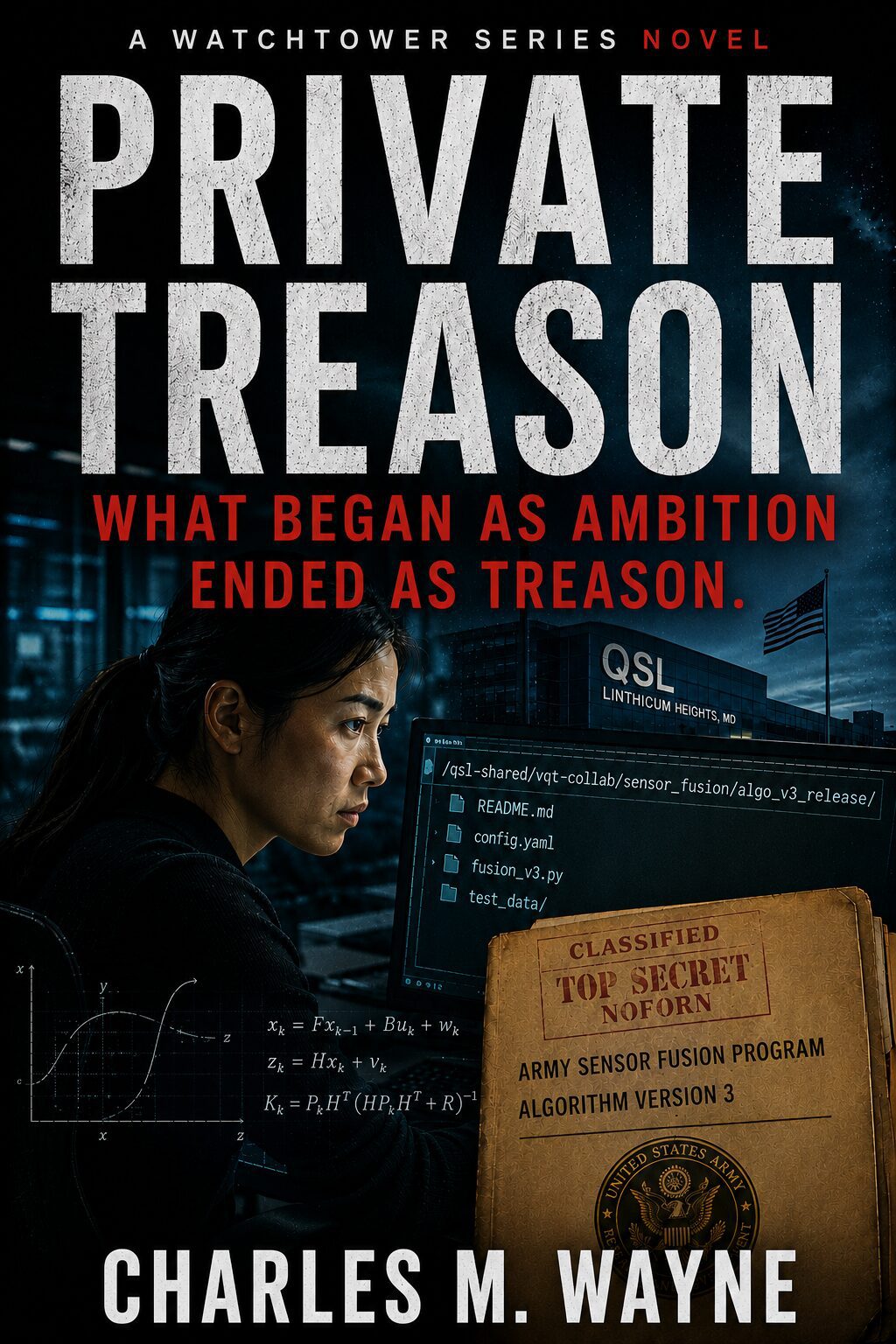

Private Treason
What Began As Ambition Ended As Treason
Coming 2027
Linthicum Heights, MD-QSL Headquarters Thursday Evening, Late October
The building had emptied an hour ago. From her workstation in the southwest corner of the SCIF, Sophia Leung could hear the HVAC settle into its overnight cycle, the soft tick of metal contracting somewhere above the drop ceiling. The bullpen lights had switched to their second-shift dimness. Her own monitors stayed bright.
She was running a parameter sweep on a sensor calibration model that wouldn't finish until midnight. She had told herself she would stay until the second batch completed, then go home. That was three hours ago. The third batch was halfway through.
This was the part of the job she loved. The empty hum of the secured facility, the absence of meetings, the clean line of work that ran between her hands and the screen. Her phone was in a locker by the security door. Her smartwatch was in the same locker. Inside the SCIF there was no email or text, no notification of any kind. Only the work.
She finished a code block and stretched her arms above her head, neck stiff. Her dissertation advisor at MIT had warned her about this kind of work. About the way a quantum physicist forgets her own body when the math is going well.
She had been good at forgetting her body since she was twelve.
The query she had typed twenty minutes ago for the sensor noise tables had finished. The terminal blinked, waiting. She turned back to her main monitor and opened the file browser. She intended to pull the Kalman gain matrices for the L-band signal processing module. She typed the path, hit Tab, and waited for the autocomplete.
The system filled in something she did not expect.
/qsl-shared/vqt-collab/sensor_fusion/algo_v3_release/
She frowned. That wasn't where the gain matrices lived. That was the VQT shared workspace. She hit Backspace, retyped, and got the same suggestion. Her path and the VQT path shared the first six characters. She must have hit Tab too early.
She started to correct it. Then she paused.
The version number caught her eye. algo_v3_release. She had been working on algorithm version 3 for the Army program for the last six weeks. The classified algorithm. The one whose existence was not supposed to be acknowledged outside the SCIF.
The VQT workspace was not supposed to have anything called algo_v3.
She stared at the path. The text cursor blinked at the end of it.
She told herself it was a coincidence. The VQT team developed their own algorithms for the commercial product. They tracked versions of their own. Algorithm version 3 in the VQT workspace was probably their third iteration of the commercial sensor fusion code, which had nothing to do with her classified version 3 except the number.
She clicked the path. The folder opened.
There were four files inside. A README. A configuration file. A Python module called fusion_v3.py. And a directory of test data.
She opened the README first. Her hand was steady on the mouse, but she noticed the steadiness, the way a person notices their own breathing when the air in a room has changed.
The README described a commercial sensor fusion algorithm for autonomous vehicle navigation. Subway tunnels, urban canyons, underground parking structures. GPS-denied environments where the autonomous vehicle market wanted alternative positioning. The text was clear, marketing-adjacent, the kind of language she had reviewed for VQT documents over the last quarter. The classification banner at the top read UNCLASSIFIED.
She opened the configuration file.
The configuration file contained the parameters that controlled the fusion algorithm's behavior. Sensor noise models. Confidence weights. Threshold parameters for the magnetometer drift compensation.
She scrolled slowly.
The magnetometer noise model used the empirical covariance from her own Army test runs. She recognized the values because she had derived them herself, in this SCIF, from data the Army had collected at White Sands and Yuma during the Phase II trials. The values were specific to one particular generation of quantum magnetometer hardware. They were not the kind of thing you could fit from public datasets. They were not the kind of thing a commercial program would have any reason to know.
She kept scrolling. The Kalman filter gain initialization. The thermal drift compensation table. The lock-loss detection threshold. All of them tuned to the Army's hardware in ways that did not come from public sources.
She felt the SCIF go very quiet around her.
She closed the configuration file and opened the Python module. The architecture matched the architecture she had drafted for the classified system. Some function names had been changed and some constants renamed, but the overall structure was hers.
She did not know how long she sat looking at the screen. Her hand had moved away from the mouse at some point and her arm felt heavy. The HVAC ticked. The third batch of her own parameter sweep finished in the background and her terminal beeped softly. She did not register it.
Footsteps in the hallway outside the SCIF. Soft, unhurried. They passed and continued.
She closed the Python module. She left the file browser open on the algo_v3_release folder.
She told herself this could still be explained. Maybe the VQT team had been given a sanitized version of her algorithm to start from. Maybe the corporate side had cleared a tech transfer she didn't know about. Maybe there was a signed authorization sitting in someone's office that simply hadn't been distributed to engineering yet. A hundred ways this could be legitimate. One way it couldn't be.
She knew which one of those probabilities was true. She had known when she saw the magnetometer noise values.
But she didn't have to know yet. Not officially. Not in a way that committed her to anything.
She typed a new query into her terminal, the one she had meant to type ten minutes ago. The Kalman gain matrices for the L-band module. She pulled them, copied the relevant entries into her notebook, and closed the file. Her hands were steady. They had always been steady.
Then she opened her email. The classified system, walled off from anything outside the SCIF, with its own internal directory of cleared personnel.
She searched for any recent communication regarding VQT tech transfer authorizations. She found the routine emails she had seen before. JV scope memos. Quarterly review summaries. A note from Compliance about the next data sharing audit. The usual.
She scrolled down further.
There. An email from three weeks earlier. From: D. Bailey, Palisade Capital Group. To: T. Maier, with several cc lines including Legal, Compliance, and the head of the JV technical committee. Subject: VQT Phase II Algorithm Release – Approval.
She opened it.
The email was short and confident. Bailey was approving the release of "Phase II algorithm packages" to VQT under the existing JV technology sharing protocol. He referenced an attached memo from Compliance and a separate sign-off from Legal. The release included items the corporate operating committee had reviewed and deemed within scope of the commercial product line. He thanked Tripp for moving the program forward and said he looked forward to the Q4 milestone review.
She read it twice.
The signature block listed Bailey's office in McLean and a phone number. At the bottom, in a smaller italic font, a quote from Eisenhower about being prepared. She had seen the same quote in his prior emails.
She clicked the attached Compliance memo and read it. The memo described the release in general terms. It listed three algorithm packages by reference number. It did not list specific parameters or test data sets. It used the phrase "non-classified derivative work" three times in two paragraphs.
She thought about the magnetometer noise model. The values from White Sands and Yuma.
Non-classified derivative work. She turned the phrase over in her mind. The Compliance memo was technically true if you accepted a definition of "derivative" that allowed the derivative to inherit calibration parameters that only existed because of the classified parent work. She could argue both sides of that question in her head. She had argued both sides of similar questions before, in academic settings, where the worst consequence of being wrong was a sharp word from a tenured man.
She closed her email.
She sat for a while. The bullpen outside the SCIF was dark. Through the small reinforced glass window in the SCIF door she could see the empty hallway and the exit sign at the far end glowing red.
Footsteps again. Closer this time. She heard the badge reader at the SCIF door, the soft click of the lock disengaging.
The door opened and Tripp Maier walked in.
He wore a dark wool sweater over a button-down, jeans, the same boots he wore every Thursday because he taught a graduate seminar at UMD on Friday mornings and the boots were comfortable for the drive. His hair was a little gray at the temples and his face was a little tired. He held a paper coffee cup that probably had nothing left in it.
"You're still here." His voice was quiet, the way it was after seven.
"Last batch finishes in forty minutes." She did not turn her chair to face him. She wanted him to see only the side of her face, in case she had a face she didn't know about.
"You're going to wear yourself out, Fia." He said her name the way he always said it, with the casualness of long acquaintance. He had hired her seven years ago. He had stood with her at the small ceremony when she became a US citizen, in a federal courthouse in Greenbelt, and he had held the flag.
"I'll go home after the batch."
"Promise me."
She turned her chair partway. She made her face do the thing it always did when she talked to Tripp. The slight smile. The small softening around the eyes.
"I promise."
He nodded once. He looked tired in a way she had been seeing more often in the last two months. Not the tired of long days. The tired of something else. He looked at her workstation, at the screen, at her, at the screen again.
"Anything interesting?" he asked. His voice was as light as he could make it.
For a fraction of a second she thought about telling him. She thought about saying, Tripp, I just found something in the VQT workspace that shouldn't be there. She thought about watching his face when she said it.
She didn't.
"Calibration sweep for the L-band module," she said. "Nothing interesting. Just slow."
He smiled a small smile. "All right. Go home, Fia. The math will still be here."
He left. The badge reader clicked. The door sealed behind him.
She sat for another minute.
She opened the algo_v3_release folder again. She looked at the fusion_v3.py file. She thought about Compliance memos, about a man in McLean whose signature quote about preparedness had been read by every cleared employee in the company every time he sent an email. She thought about the noise values from White Sands.
Then she did the thing she would not let herself think about while she did it.
She inserted a small flash drive into the dedicated transfer port at her workstation. The port was for authorized transfers under specific procedures, and her credentials authorized her to use it for a limited set of purposes that did not include what she was about to do. The system logged the insertion. Her hands knew the keys. She copied the four files out of the VQT folder onto the drive, including the configuration file with the magnetometer values, and ejected the drive cleanly. She slid it into the small zip pocket of her bag.
She closed the file browser. She locked her workstation. She picked up her bag.
She left the SCIF through the inner door, then the outer, and signed out at the security desk. She retrieved her phone and her smartwatch from her locker. The night guard nodded at her without looking up from his book.
In the parking lot the rain had started. She sat in her car for a long time with her hand on the ignition. The lot was almost empty. Tripp's car was still there, two rows over. The bay of the loading dock had a single light over it, yellow in the rain.
She did not know what she was going to do next. She knew she had stopped having the option of doing nothing.
She started the car. She drove home.
In her apartment in Columbia she took off her coat, dropped her bag on the kitchen counter, and poured a glass of water she did not drink. She stood at the window looking at the lights of the buildings across the way.
When she finally opened her bag to find her phone charger, the flash drive was there. She had been carrying it without thinking about it, the way she carried her badge or her keys.
She looked at it for a long time.
She set it down in the small white ceramic dish on the counter where she kept loose change and earrings she meant to put away. She did not take it to her laptop.
The rain on the window was a soft, steady sound.
This is the seventh book in the Watchtower Series, introducing Team Watchtower—an elite investigative unit within the U.S. Army Counterintelligence Command (ACIC).
Most espionage thrillers revolve around the CIA. However, following the National Defense Authorization Act (NDAA) of 2025, ACIC was formally elevated from a primarily intelligence-focused agency into a hybrid counterintelligence and law enforcement command. This landmark change granted its civilian special agents limited federal arrest authority for national security crimes and expanded its operational scope beyond military installations.
Today, ACIC stands as the only counterintelligence organization with both foreign and domestic jurisdiction—and the legal authority to investigate, detain, and prosecute espionage within and beyond U.S. borders.
Order Private Treason
(Under Construction))
EBOOK
AUDIO
Coming Soon











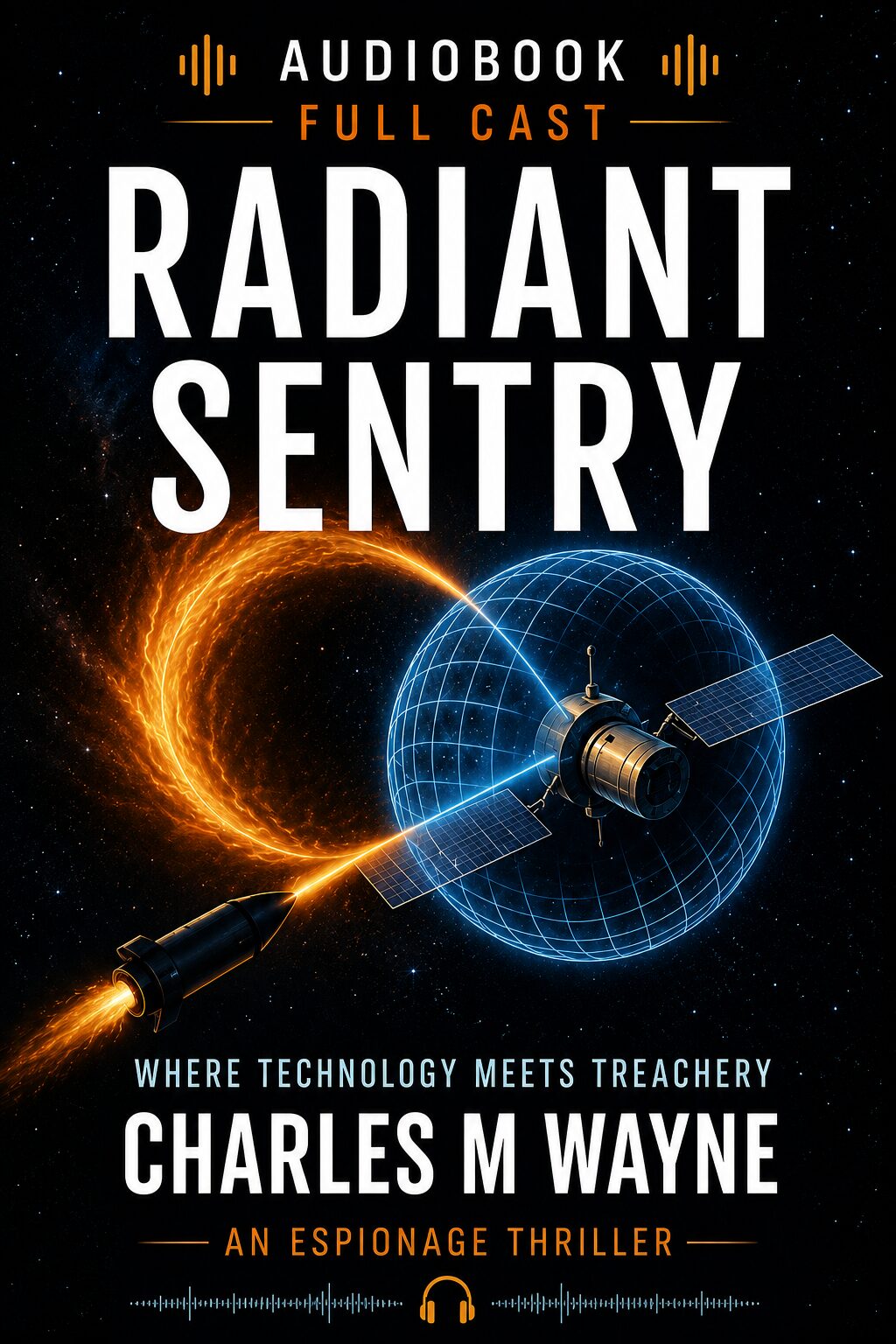
Full cast audio book.
Publishing Date June 30, 2026

Watchtower
Free Espionage Puzzles

Contact Publisher
publisher@dragonfly.associates

Contact Author
author@spyscribe.com